TL;DR: Mold spores are always present in indoor air. After water damage, they need only 24 to 48 hours of moisture, warmth, and an organic surface to begin colonizing. The clock starts the moment water contacts drywall, wood framing, carpet, or insulation. Drying materials to pre-loss moisture levels within that window is the single most effective way to prevent a mold problem from following a water event.
If you are reading this after a leak, a burst pipe, or a flooding event, the most important thing to know is that you probably have less time than you think. Most homeowners assume mold takes weeks to appear. It does not. The EPA notes that mold can start growing in as little as 24 to 48 hours under the right conditions, and coastal areas with naturally higher ambient humidity, like Ventura County, give spores an even shorter runway. The good news: fast, professional drying stops mold before it starts.
How quickly does mold actually grow after water damage?
Mold can begin colonizing wet building materials within 24 to 48 hours of a water event. That is not a worst-case figure. It is the standard window cited by the IICRC, the EPA, and the CDC. In the first 24 hours, spores absorb moisture and begin germinating. Between 24 and 48 hours, hyphae (the root-like threads of mold) start penetrating porous surfaces. By 72 hours, visible colonies can appear on drywall paper, wood studs, and carpet backing.
The speed depends on three variables: temperature, humidity, and the material being wetted. Mold thrives between 60 and 80 degrees Fahrenheit, which is exactly the indoor temperature most California homes maintain year-round. Relative humidity above 60 percent accelerates growth significantly. Coastal Ventura County averages ambient relative humidity in the 70 to 80 percent range during marine layer months, which means moisture in building materials does not evaporate on its own the way it might in a drier inland climate. That ambient humidity is a real accelerant, not a hypothetical risk.
Porous materials are the highest priority. Drywall (specifically the paper facing), OSB sheathing, wood framing, and carpet padding can all support mold growth faster than tile, concrete, or metal. A Category 1 clean-water event (burst supply line) still saturates drywall and framing, and those materials behave the same way regardless of the water source.
Does water damage always cause mold?
Water damage does not always cause mold, but it always creates the conditions for it. Whether mold actually grows depends on how quickly the materials are dried. If structural materials are brought back to normal moisture content, typically below 16 percent for wood and below 1 percent for concrete, before the 48-hour window closes, mold colonization is unlikely. If materials stay wet beyond 48 to 72 hours, the probability of mold growth rises sharply.
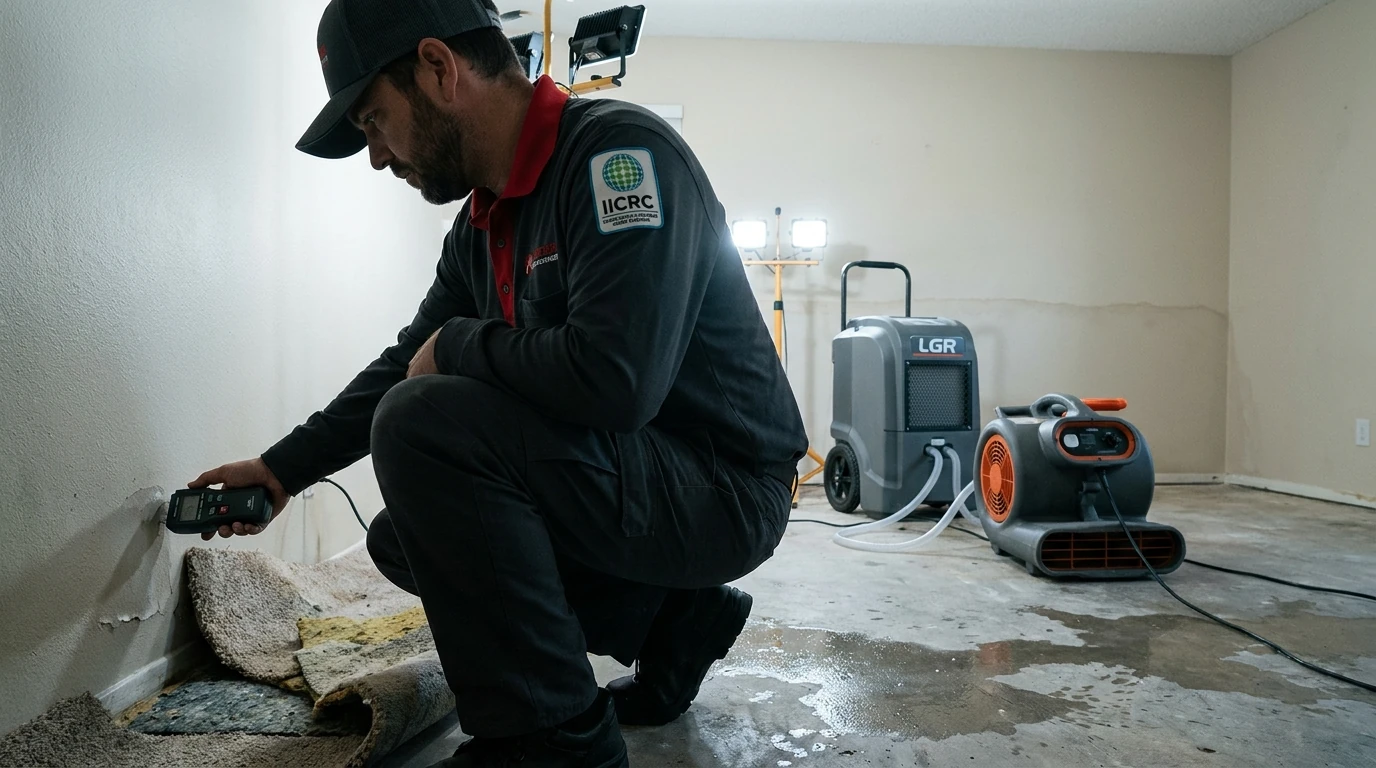
The CDC confirms that controlling moisture is the key to controlling mold. Professional water damage restoration uses calibrated equipment to make that happen: LGR (low-grain refrigerant) dehumidifiers pull moisture from the air, high-velocity air movers accelerate evaporation from surfaces, and thermal hygrometers track moisture levels in real time. This is not something a box fan and open windows can replicate, especially in a coastal climate where the outside air is already saturated.
Two situations almost always lead to mold even when the initial water event was minor:
- Slow leaks left undetected. A pinhole in a supply line behind a wall, a slow roof drip, or a weeping irrigation connection can wet framing and insulation for weeks before anyone notices. By then, mold is established and remediation is required, not just drying.
- Incomplete drying. A homeowner extracts standing water and runs a household dehumidifier, but does not address moisture trapped inside wall cavities or under flooring. Surface readings look dry; the structure is not.
If you are unsure whether your structure dried completely after a past event, our post on 7 Signs You Have Hidden Mold covers the indicators worth checking.
What are the early signs of mold after water damage?
Early mold growth often looks like nothing at all. The first signs are frequently sensory rather than visual: a musty, earthy smell in a room that did not smell that way before, or a slight discoloration on drywall that could be mistaken for a water stain. Do not wait for visible fuzzy growth before acting.
Here is what to look for in the first few days after a water event:
- Musty odor in the affected room or adjacent spaces, especially noticeable when the HVAC runs
- Discoloration on drywall or ceilings: gray, brown, or greenish patches, often starting at the waterline
- Warping or bubbling paint or wallpaper, which indicates moisture trapped beneath the surface
- Soft or spongy drywall when pressed gently
- Visible dark spotting on wood framing, subfloor, or the back of baseboards
- Condensation on windows or interior walls in rooms that did not show it before
If any of these appear within the first week after water damage, treat it as confirmation that drying was incomplete, not as a reason to wait and see. Mold remediation is significantly more involved and more expensive when colonies are established versus when they are caught early. Our water damage restoration service includes post-drying moisture verification specifically to catch this before it becomes a mold problem.
How do you prevent mold after water damage?
Preventing mold after water damage comes down to aggressive, documented drying within the first 24 to 48 hours. These are the steps that actually work:
- Extract standing water immediately. Every hour of standing water increases saturation depth. Truck-mounted extraction removes far more water than wet-vacs.
- Deploy drying equipment within hours, not days. LGR dehumidifiers and air movers need to run continuously, typically for 3 to 5 days for a standard Category 1 loss.
- Measure, do not guess. Technicians use pin-type and pinless moisture meters to read moisture content inside walls and under flooring. Readings are logged daily to confirm drying progress.
- Address wall cavities. Drywall is often drilled or removed to allow air circulation inside wall bays where insulation has absorbed water. This step is frequently skipped in DIY attempts.
- Control the ambient environment. In a coastal climate, closing windows and running dehumidifiers is counterintuitive but correct. Pulling outside humid air in slows drying.
- Verify before closing up. Final moisture readings should match pre-loss baseline readings (or published IICRC S500 standard reference values) before any reconstruction begins.
The IICRC S500 standard is the industry reference document for water damage restoration. Drying to its specified moisture content thresholds is what separates a properly closed loss from one that will grow mold behind new drywall.
When should you call a mold remediation company?
Call a mold remediation company if visible mold is present on more than 10 square feet of surface area, if mold is inside HVAC ductwork, or if anyone in the home has respiratory symptoms that started after a water event. The EPA’s 10-square-foot threshold is a practical guideline: smaller areas may be manageable with proper containment and cleaning, but larger areas require professional containment, HEPA air filtration, and disposal of affected materials per established protocols.
Also call if you had water damage and did not have professional drying performed, even if you cannot see mold yet. A moisture assessment can determine whether conditions exist for growth before a problem becomes visible. Catching it at that stage is far less disruptive than full remediation after colonies are established.
California Restoration West holds IICRC AMRT (Applied Microbial Remediation Technician) certification and handles both the water damage drying and the mold remediation side of a loss, so you are not coordinating two separate contractors. If you had recent water damage and want to know where your structure stands, schedule a moisture assessment before the 48-hour window becomes a longer problem.
About California Restoration West
California Restoration West is an IICRC Certified Firm serving Ventura, CA and surrounding Ventura County communities since 2025. The team holds IICRC certifications in Water Damage Restoration (WRT), Applied Microbial Remediation (AMRT), and Applied Structural Drying (ASD), and is OSHA trained. Services include water damage restoration, mold remediation, storm damage restoration, contents restoration, crawl space encapsulation, and emergency water cleanup. California Restoration West is licensed, insured, locally owned, and available 24/7 for emergency response throughout Ventura County.
Video Transcript
If your home just had a water leak, here’s the most important thing you need to know: mold can start growing in as little as 24 hours. Mold spores are always floating in your indoor air. All they need is moisture, warmth, and a surface like drywall or wood to start colonizing. The EPA, CDC, and IICRC all agree: within 24 to 48 hours, those spores begin taking root. By 72 hours, visible colonies can appear. Coastal areas like Ventura County have naturally high humidity, which shortens that window even further. Your home’s air simply can’t dry itself out fast enough. Watch for these early warning signs: a musty smell, discolored drywall, bubbling paint, or soft spongy walls anywhere near the water damage. A box fan and open windows won’t cut it. Professionals use industrial dehumidifiers and air movers to pull moisture out of wall cavities and subfloors. Moisture meters check what your eyes can’t see. Walls need to reach safe moisture levels before drying is truly complete. Hidden slow leaks are especially dangerous. By the time you notice a smell or stain, mold may already be established inside the wall. Fast professional drying within that 48-hour window is the single best way to stop mold before it ever starts, saving you time and money. Don’t wait and see. Call California Restoration West at 805-290-7292 for a free estimate. The sooner you act, the better your outcome.