TL;DR: Water damage restoration in California typically costs $1,500 to $15,000 for residential losses. Most homeowners in Ventura County pay between $3,000 and $7,500 for a mid-sized event like a burst pipe or appliance leak. The final number depends on how much water entered, how long it sat, what materials got wet, and whether mold developed before crews arrived.
You just found water where it shouldn’t be. Maybe a supply line failed behind the refrigerator overnight, or a pipe let go during the night and soaked two rooms of hardwood. Now you’re staring at a quote or trying to figure out what your insurance will cover before you call anyone. This guide gives you the real cost ranges for water damage restoration in California, what drives the price up or down, and what the process actually looks like from first call to final dry-out.
How Much Does Water Damage Restoration Cost in California?
In California, water damage restoration typically costs $1,500 to $15,000 for a residential loss, with the average claim landing between $3,000 and $7,500. Catastrophic losses involving structural materials, flooring, cabinetry, or mold growth can exceed $20,000.
The ranges below reflect typical industry pricing for Ventura County and the surrounding Southern California coastal market. Every loss is different, and California Restoration West provides a written scope before any work begins.
| Scenario | Typical Cost Range |
|---|---|
| Small appliance leak, single room, clean water | $1,500 - $3,500 |
| Burst pipe, 2-3 rooms, Category 1 water | $3,000 - $7,500 |
| Bathroom overflow, subfloor affected | $4,000 - $9,000 |
| Category 2 water (washing machine, dishwasher) | $5,000 - $12,000 |
| Category 3 water (sewage backup, floodwater) | $8,000 - $20,000+ |
| Crawl space flooding with structural drying | $6,000 - $15,000 |
These are mitigation and drying costs only. Reconstruction (replacing drywall, flooring, cabinetry) is a separate line item, typically adding $2,000 to $10,000 or more depending on finishes.
What Factors Drive the Cost Up or Down?
The single biggest cost driver in water damage restoration is how long the water sat before extraction began. A clean water pipe burst caught within two hours is a fundamentally different job than the same pipe discovered 48 hours later.
Here are the factors that move the number most:
Water category. The IICRC S500 Standard classifies water into three categories. Category 1 (clean water from a supply line) is the least expensive to remediate. Category 2 (gray water from appliances or toilets without solids) requires more protective measures. Category 3 (black water from sewage, rising groundwater, or floodwater) requires full PPE, antimicrobial treatment, and disposal of porous materials that cannot be dried in place.
Water class and affected materials. Class 1 losses affect a small area with low-porosity materials. Class 4 losses involve deeply saturated materials like hardwood, concrete, or plaster that require specialty drying techniques and significantly more equipment time.
Square footage affected. Restoration pricing scales with the number of affected rooms, linear feet of wet wall cavity, and square footage of flooring that needs to come up.
Response time. Mold can begin colonizing wet porous materials within 24 to 72 hours under the right temperature and humidity conditions, according to the EPA’s mold guidance. A loss that sits over a weekend before anyone calls often doubles the remediation scope.
Structural materials involved. Wet drywall, insulation, and subfloor almost always require removal. Wet hardwood may be salvageable with aggressive drying if caught early. Wet engineered wood and laminate typically cannot be saved.
Crawl space involvement. Ventura County homes with raised foundations are common, and water that reaches the crawl space adds cost. Standing water under the house requires extraction, and the framing and insulation may need full replacement. Crawl space encapsulation after drying protects against future moisture intrusion.
What Does the Restoration Process Actually Look Like?
Water damage restoration follows a defined sequence. Knowing the steps helps you understand what you’re paying for and what questions to ask any company you hire.
Step 1: Emergency extraction. Crews arrive and remove standing water using truck-mounted or portable extraction units. For a two-room loss, this typically takes one to three hours.
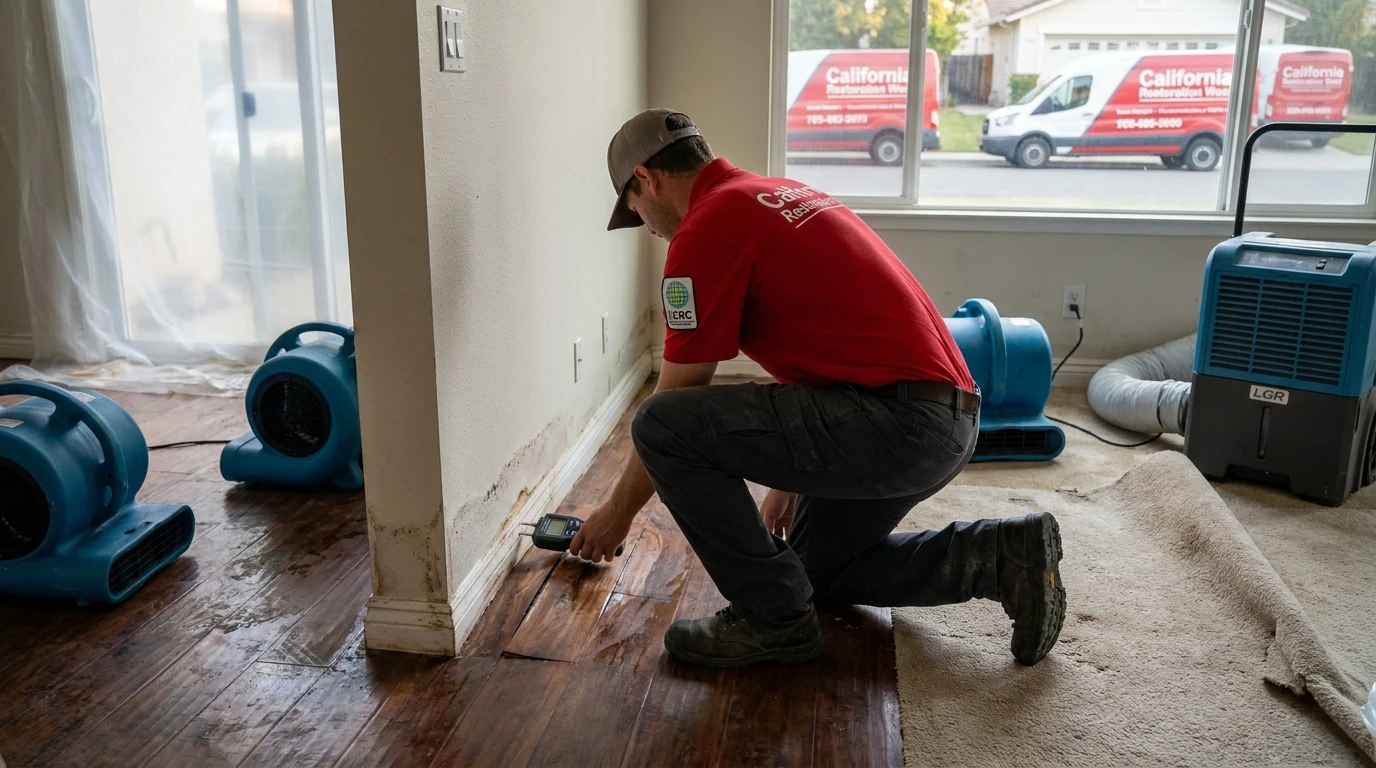
Step 2: Moisture mapping. Technicians use thermal imaging cameras and penetrating moisture meters to document the full extent of saturation, including inside wall cavities and under flooring. This documentation matters for your insurance claim.
Step 3: Controlled demolition. Wet drywall, insulation, and flooring that cannot be dried in place are removed. This is not destructive for the sake of it. Wet drywall left in place traps moisture and feeds mold growth. The IICRC S500 sets the standard for what must come out versus what can stay.
Step 4: Structural drying. Commercial-grade LGR (low-grain refrigerant) dehumidifiers and high-velocity air movers are placed according to a drying plan. A typical residential loss requires three to five days of continuous drying. Technicians return daily to take moisture readings and adjust equipment placement.
Step 5: Antimicrobial treatment. Applied to affected structural surfaces to inhibit mold growth during and after drying.
Step 6: Final moisture verification. When readings reach the IICRC’s dry standard for the affected material type, equipment is removed and a drying report is generated. This report is what your insurance adjuster and any future buyer’s inspector will want to see.
Step 7: Reconstruction. Once the structure is certified dry, repairs begin. New drywall, insulation, flooring, and paint restore the space. California Restoration West handles water damage restoration through the drying phase; reconstruction scope is documented in the initial written estimate.
If you’re dealing with a burst pipe right now and haven’t started yet, the Burst Pipe Emergency Checklist walks through the first steps to take before the crew arrives.
Will Homeowners Insurance Cover Water Damage Restoration in California?
Most standard California homeowners policies cover sudden, accidental water damage but exclude gradual leaks and flooding. The distinction matters more than most homeowners realize.
Covered losses typically include burst pipes, failed appliance supply lines, and sudden roof leaks that allow water intrusion. The key word is sudden. A slow leak under the kitchen sink that went unnoticed for three months is typically denied as a maintenance failure.
Flood damage from rising groundwater or storm surge is not covered under a standard homeowners policy. That requires a separate NFIP flood policy or private flood coverage.
For covered losses, here is what the claims process typically looks like:
- Call your insurer to open a claim and get a claim number before significant work begins (emergency extraction is always fine to start immediately).
- Document everything with photos and video before extraction.
- A restoration company like California Restoration West generates a detailed scope of loss using Xactimate, the industry-standard estimating platform that most adjusters work from.
- The adjuster reviews the scope, and a settlement is negotiated based on your policy limits and deductible.
For a deeper look at what policies typically cover and how to document your claim, see the Does Homeowners Insurance Cover Water Damage? guide.
One practical note: do not wait for the adjuster to arrive before starting mitigation. Most policies require you to take reasonable steps to prevent further damage. Waiting 48 hours for an adjuster visit while water sits in your walls can result in a partial denial for the mold that develops in the meantime.
What Should You Do Right Now?
If you have active water damage, the first priority is stopping the source. Shut off the supply valve at the affected fixture or the main shutoff at the meter. Then call for extraction. Every hour of additional saturation expands the affected area and the cost.
For Ventura homeowners dealing with a loss right now, California Restoration West is available 24/7 at (805) 290-7292. The crew is IICRC-certified in Water Damage Restoration (WRT) and Structural Drying (ASD), and carries full licensing and insurance. A written scope is provided before any work begins, so you know exactly what you’re authorizing.
If you’re in the research phase, the Water Damage Restoration Cost in Ventura County post covers local pricing in more detail, and What To Do in the First 24 Hours After Water Damage walks through the immediate response steps.
About California Restoration West
California Restoration West is an IICRC Certified Firm serving Ventura, Oxnard, Thousand Oaks, Camarillo, Simi Valley, Santa Paula, and surrounding Ventura County communities. The team holds IICRC certifications in Water Damage Restoration (WRT), Applied Structural Drying (ASD), and Applied Microbial Remediation (AMRT), and is OSHA trained. Services include water damage restoration, mold remediation, storm damage restoration, contents restoration, crawl space encapsulation, and water cleanup. Licensed and insured. Available 24/7 at (805) 290-7292.