24/7 Emergency Water Damage Restoration in Casa Conejo
24/7 emergency water damage restoration in Casa Conejo, CA. IICRC-certified, insurance billing accepted. Call (805) 290-7292.
Our IICRC-certified technicians are dispatched from our Ventura, CA headquarters and are typically on-site in Casa Conejo within 60 minutes of your call.
Water damage emergency in Casa Conejo? We answer 24/7. Whether a slab leak has turned your living room into standing water or a washing machine hose let go overnight, every hour the water sits is an hour closer to drywall failure, warped flooring, and the start of mold colonization. California Restoration West is IICRC-certified in water restoration and structural drying, and we treat Casa Conejo’s inland valley conditions differently than a coastal job in Ventura or Oxnard.
Why Casa Conejo Properties See Water Damage Issues
Casa Conejo sits in the Conejo Valley, further inland than much of Ventura County’s coastline, which means hotter, drier summers and occasional intense winter storms that dump a lot of rain in a short window. Many homes in this part of the valley were built during the region’s postwar suburban expansion on concrete slab foundations, often paired with the clay-heavy soils common to inland Ventura County. Clay swells when saturated and drains slowly, so instead of water moving away from the foundation it can sit against it, working moisture upward through the slab over days or weeks. Add in irrigation systems, aging supply lines, and water heaters original to older additions, and you get a mix of slow slab leaks and sudden pipe failures that both present the same way: damp carpet, lifting baseboards, or a musty smell that shows up before anyone sees visible water.
Our Water Damage Restoration Process in Casa Conejo
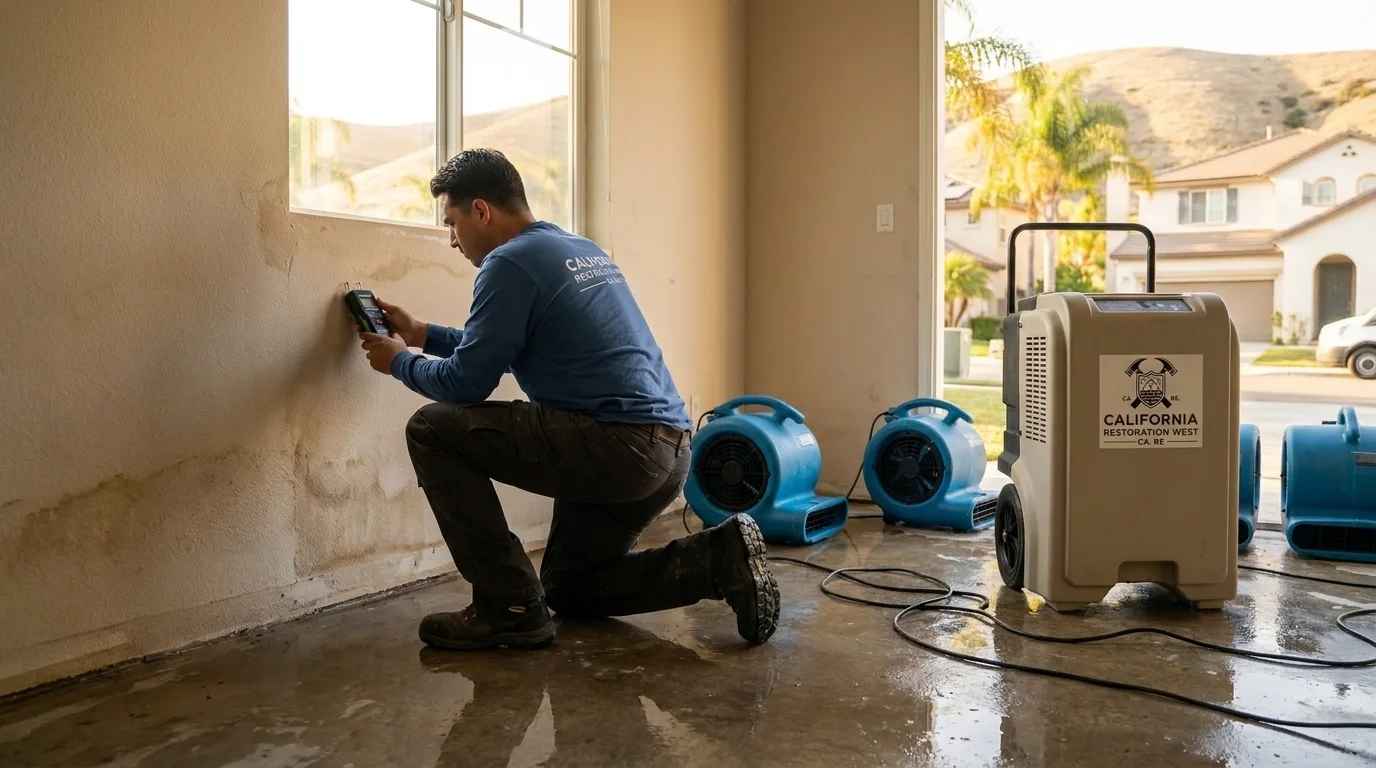
We start with moisture mapping, not guesswork. Thermal imaging and penetrating moisture meters tell us whether water is sitting at the surface or has already worked into subfloor and framing, which matters more in slab-on-grade homes where there’s no crawl space to inspect from below. Extraction comes next, pulling standing water and saturated padding before it migrates further under cabinetry or built-ins. Structural drying follows the IICRC S500 standard: we set air movers and dehumidifiers based on the actual moisture readings in the room, not a fixed timeline, and we re-check daily until materials read dry rather than just dry to the touch. In homes with clay-soil slab moisture, drying can take longer than a straightforward pipe-burst job because the ground keeps feeding moisture back into the concrete even after the visible water is gone, so we monitor slab readings past the point where carpet and drywall test dry.
Casa Conejo Insurance & HOA Coordination
Most water losses in this area get handled through a homeowner’s policy, and we document the source, affected materials, and drying progress with photos and moisture logs that carriers expect to see before approving mitigation and repair costs. If your property sits inside an HOA-governed community, we coordinate equipment staging and any required notifications so drying equipment and dumpsters don’t become a separate issue on top of the water damage itself. We don’t guarantee claim outcomes, but we build the documentation carriers actually use to process a claim without back-and-forth delays.
Equipment & Methods We Use for Water Damage
Inland heat changes how we approach drying. In peak summer, ambient humidity is already low in the Conejo Valley, which can trick homeowners into thinking a space has dried faster than it has, especially inside closed-up rooms with the AC off during a loss. We rely on calibrated hygrometers and moisture meters rather than how a room feels, pairing low-grain refrigerant dehumidifiers with high-velocity air movers positioned to hit wall cavities and subfloor, not just open floor space. For slab leaks, we sometimes bring in specialized drying mats that pull moisture directly from the concrete, which shortens the timeline compared to waiting on ambient air movement alone.
Local Note
One thing that catches homeowners off guard in this part of Ventura County: a slab leak doesn’t always show up as a wet spot. In clay-soil areas like the Conejo Valley, the first sign is often a warm patch on the floor (from a hot water line) or a baseboard that’s swollen on one wall while the rest of the room looks untouched. If you notice either, it’s worth having moisture levels checked even before you see standing water, because by the time it’s visible, the slab and subfloor have usually been wet for a while.
If water is spreading through your Casa Conejo home right now, don’t wait on it to “dry out on its own,” especially with clay soil underneath pushing moisture back up. Call California Restoration West at (805) 290-7292 for water extraction and structural drying handled by an IICRC-certified team that treats this valley’s slab and soil conditions as part of the job, not an afterthought.
Serving Casa Conejo from our Ventura headquarters — ★ 5.0 · 9 Google reviews
“Jimmy is Very Professional and knowledgeable. One of the best in the industry.” — Jeffrey, November 2025Read our reviews on Google →
Water Damage Restoration in Casa Conejo: Service Coverage
Frequently Asked Questions
How fast can you arrive for water damage restoration in Casa Conejo?
How does Casa Conejo's clay soil affect water damage restoration?
Do you work with HOA communities in Casa Conejo?
Can a slab leak in Casa Conejo cause damage before I see standing water?
What equipment do you use for structural drying in Casa Conejo homes?
Will my homeowner's insurance cover water extraction and drying in Casa Conejo?
Water Damage Restoration response in Casa Conejo
Most Casa Conejo calls see a technician on-site within 60 minutes from our Ventura headquarters.