
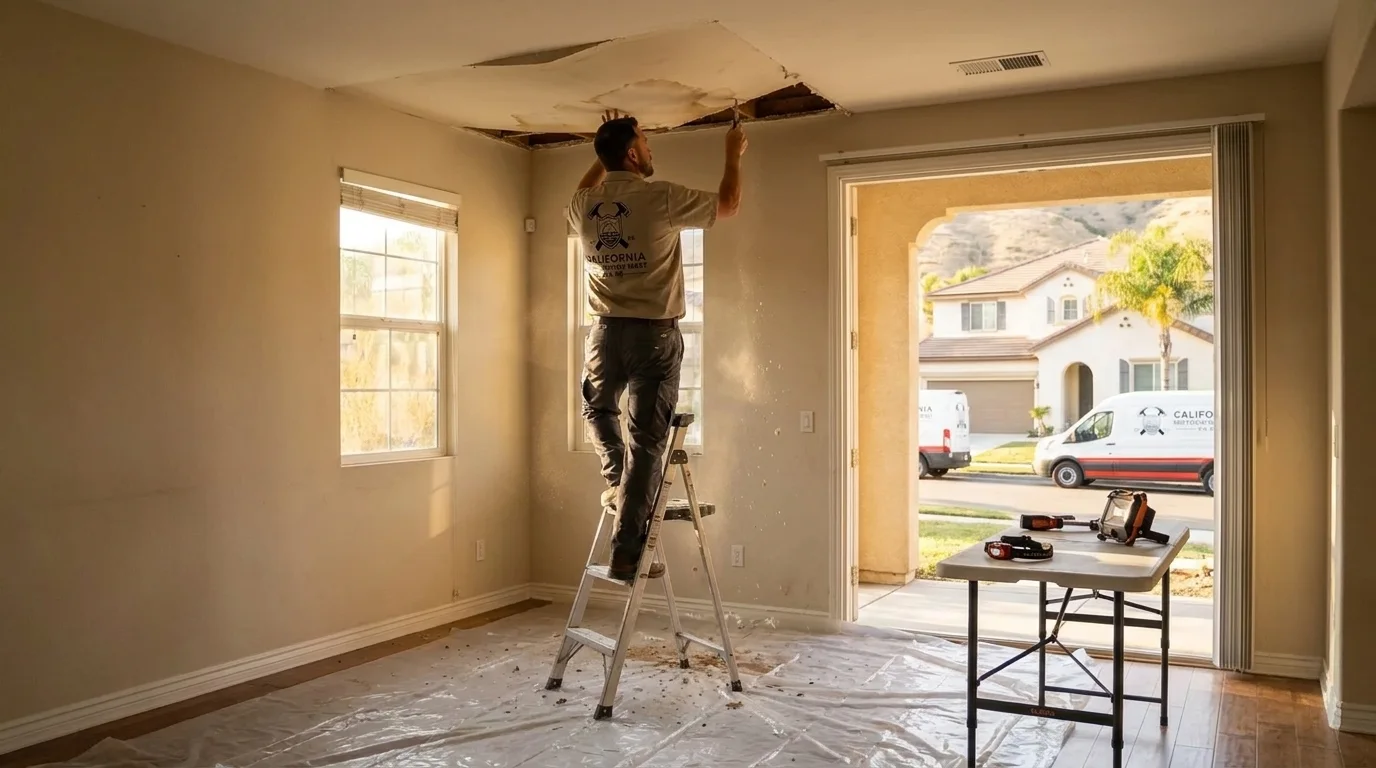
24/7 Emergency Ceiling Water Damage Repair in Ventura
24/7 emergency ceiling water damage repair in Ventura and surrounding areas. IICRC-certified, insurance billing accepted. Call (805) 290-7292.
Water stains spreading across your ceiling in Ventura? A ceiling leak rarely stays a cosmetic problem. By the time you notice a brown ring or a soft, sagging patch of drywall, water has usually been sitting in the ceiling cavity for hours or days, soaking insulation, saturating drywall paper, and working its way toward the framing. We answer 24/7. Call (805) 290-7292 before the patch grows or the ceiling lets go.
What ceiling water damage repair actually involves
Ceiling damage shows up in a few recognizable patterns: a yellow-brown stain that keeps expanding after a one-time leak, a ceiling that feels spongy or bows downward under its own weight, bubbling or peeling paint, or active dripping during or after rain. Each of these tells a different story about how much water is actually up there and how long it’s been there.
The repair work itself has two phases that shouldn’t be rushed or combined. First is drying and remediation: finding the moisture source, extracting standing water from the cavity if there is any, and drying the drywall, insulation, and framing with air movers and dehumidifiers until moisture readings return to a normal range. Second is reconstruction: cutting out and replacing saturated drywall, replacing wet insulation, treating any exposed wood framing, and repainting or re-texturing to match the existing ceiling. Skipping straight to patching without finishing the drying step is one of the most common ways these repairs fail.
Timeline matters here. Drywall and insulation that have been wet for more than 24 to 48 hours start to become a mold risk, so the gap between “I noticed a stain” and “someone opened the ceiling to check” is the single biggest factor in how large the repair ends up being.
Our process
- Source identification. Before anything is cut open, we trace the leak back to its origin, a roof penetration, a failed flashing, an upstairs plumbing line, an HVAC condensate line, or a tub/shower pan. Repairing the ceiling without stopping the source guarantees a repeat visit.
- Moisture mapping. We use moisture meters and, where needed, thermal imaging to map how far the water has traveled laterally inside the ceiling cavity. Water rarely stays directly above the stain, it follows joists and settles at low points.
- Controlled demolition. Affected drywall is cut back to dry, sound material, not just to the visible stain. Wet insulation is removed and bagged. This is also when we check the framing for warping, rot, or staining that needs treatment before anything gets closed back up.
- Structural drying. Air movers and dehumidifiers are placed to dry the remaining framing and any adjacent wall cavities, with moisture readings logged until the space reads dry. For contaminated water sources (an overflow from a toilet line versus clean supply line water), containment and additional protocols apply.
- Rebuild and finish. New drywall is hung, taped, textured to match the existing ceiling profile, primed, and painted. We provide a written scope before this phase begins so there are no surprises about what’s being replaced versus patched.
What separates a good ceiling water damage response from a bad one
The most common shortcut is patching over a stain with stain-blocking primer and new paint without ever opening the ceiling to confirm it’s dry. The stain may not reappear immediately, but trapped moisture behind an unopened cavity is exactly the condition mold needs, and it often resurfaces as a worse stain, a musty odor, or a soft spot months later.
A second mistake is treating every ceiling leak as a simple drywall swap. If the leak came from an upstairs bathroom or a roof valley, the source needs its own repair, usually by a plumber or roofer, and that work needs to happen before or alongside the ceiling repair, not after. Insurance adjusters pay close attention to this sequencing: documentation showing the source was identified and addressed, with moisture readings taken before the ceiling was closed back up, supports a cleaner claim than photos of a finished patch with no record of what was underneath it.
Good operators also distinguish between a stain from a one-time event (a tub overflow, a single hard rain through a damaged flashing) and an active or recurring leak. The repair scope, and sometimes the insurance coverage, depends on which one it is.
What does ceiling water damage repair cost?
Costs vary with how much drywall and insulation need to be removed, whether framing is affected, and the ceiling’s texture and height. These are typical industry ranges, not a quote, every loss is different, and California Restoration West provides a written scope of work before any repair begins.
| Scenario | Typical range |
|---|---|
| Small stain, drywall intact, no demo needed | $300 - $800 |
| Single section cut, dried, and patched | $800 - $2,500 |
| Full ceiling section replacement with insulation | $2,000 - $5,500 |
| Textured or vaulted ceiling match and repaint | $1,500 - $4,000 |
| Damage extending into framing or adjacent walls | $4,000 - $9,000+ |
Homeowners insurance typically covers sudden and accidental water damage, such as a burst supply line or a sudden roof failure during a storm, but usually excludes damage from long-term neglected leaks or deferred roof maintenance, so documentation of the source and timeline matters for the claim.
Seasonal & regional considerations
Ventura’s rainy season, generally December through March, is when roof-sourced ceiling leaks spike, especially in homes with older tile or built-up flat roofs where flashing and underlayment degrade over time. Coastal humidity and marine moisture also mean a ceiling cavity that’s been wet for a few days dries more slowly here than it would in a drier inland climate, which is part of why mechanical drying rather than just time matters for these repairs.
Service area
We repair ceiling water damage throughout Ventura and surrounding communities, including Oxnard, Camarillo, Thousand Oaks, and Santa Paula.
If you’re looking at a stain that’s growing, a ceiling that’s starting to sag, or water that’s actively coming through, don’t wait for it to dry on its own. Schedule your ceiling moisture assessment with California Restoration West at (805) 290-7292.
Frequently Asked Questions
Does homeowners insurance cover ceiling water damage repair?
My ceiling has a water stain but doesn't feel soft. Do I still need repairs?
How long does it take to dry a ceiling cavity before repairs can start?
Can you repair the ceiling without fixing the leak source first?
Will the repaired section of ceiling match the rest, especially if it's textured?
Looking for the best ceiling water damage repair company in Ventura?
California Restoration West provides ceiling water damage repair in Ventura, CA and the surrounding area, and has served local property owners since 2025. Customers rate us 5.0 out of 5 stars across 9 Google reviews. We answer calls 24/7 — call (805) 290-7292 for immediate help.
Need Ceiling Water Damage Repair now?
We respond 24/7 across Ventura and surrounding CA cities.
Related Coverage
- Our Restoration Services
- Contact California Restoration West
- Restoration Services in Camarillo
- Restoration Services in Carpinteria
- Restoration Services in Castaic
- Restoration Services in Fillmore
- Restoration Services in Hasley Canyon
- Restoration Services in Lake Sherwood
- Restoration Services in Mira Monte
- Restoration Services in Moorpark
- Restoration Services in Oak Park
- Restoration Services in Oak View
- Restoration Services in Ojai
- Restoration Services in Oxnard