Industrial Restoration in Ventura
24/7 industrial restoration in Ventura and surrounding areas. IICRC-certified, insurance billing accepted. Call (805) 290-7292.
Industrial water or fire damage in Ventura? A burst process line, a tripped sprinkler head, or a fire in a production area doesn’t just damage a building, it stops output. California Restoration West answers 24/7 and scopes industrial losses with the same urgency a plant manager has: get the facility safe, get moisture out of the slab and structure, and get production areas back online in sections instead of waiting on the whole building.
What industrial restoration actually involves
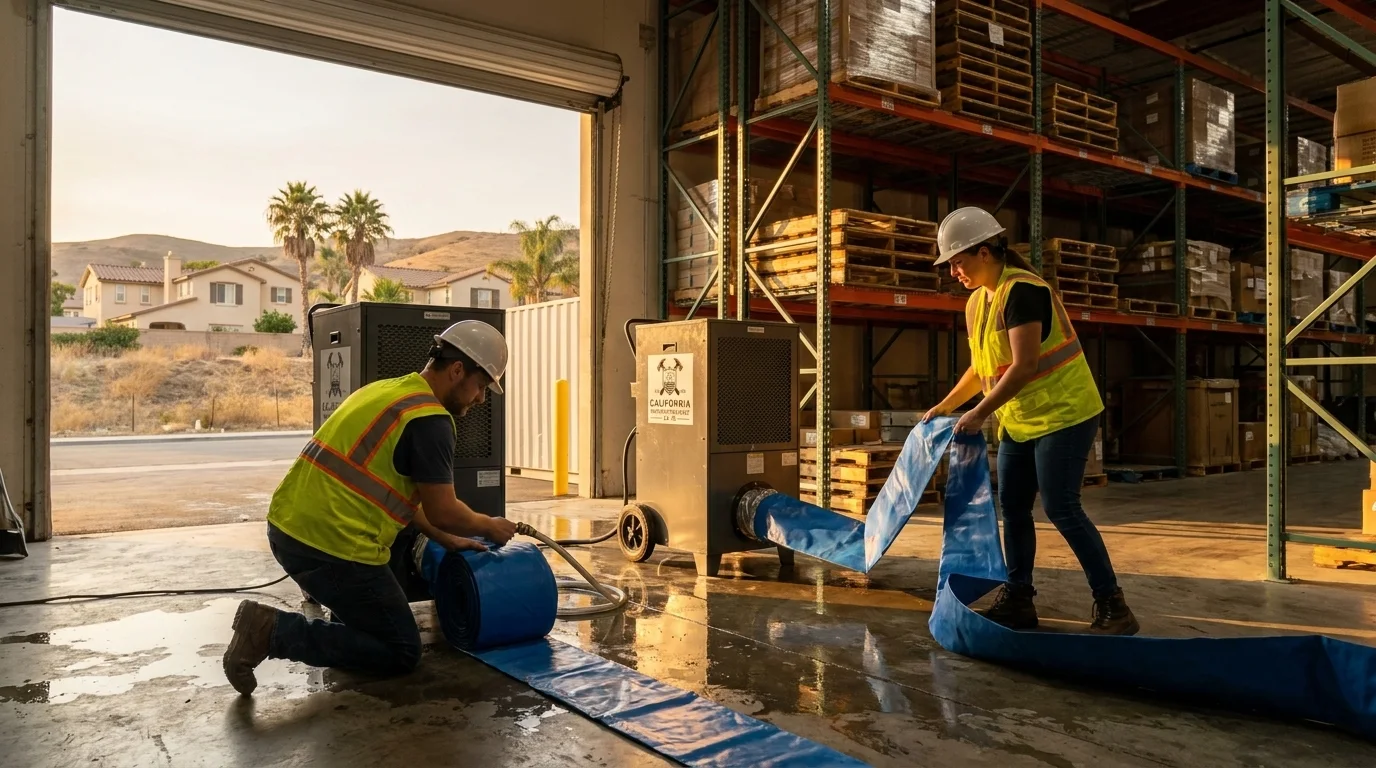
Industrial restoration covers water, fire, and smoke losses in warehouses, manufacturing plants, distribution centers, and processing facilities, spaces with concrete slabs, high ceilings, exposed steel, racking systems, and process equipment that behave differently than residential drywall and carpet. A standing-water event in a 40,000 square foot warehouse isn’t handled with the same equipment as a flooded living room. It takes trailer-mounted extraction units, desiccant dehumidifiers sized for large open cubic footage, and moisture mapping across slab sections that can hold water in ways surface readings miss. Fire losses in industrial settings carry their own complications, soot from burning plastics, packaging, or chemical stock behaves differently than residential smoke residue and often requires different cleaning agents and ventilation protocols. Our crews are IICRC-trained in water (WRT), structural drying (ASD), and mold (AMRT), and OSHA-trained for work on active industrial sites, which matters when restoration has to happen around forklifts, racking, and live utilities.
Our process
- Site safety and hazard assessment. Before anything else, we identify electrical hazards, chemical exposure, structural concerns, and any area that needs to be locked out before crews or equipment enter.
- Large-scale extraction. For water losses, truck-mounted and trailer-mounted extraction units pull standing water from slabs, loading docks, and pits faster than portable equipment can manage.
- Moisture mapping and zone drying. We map affected square footage by zone, not by room, placing dehumidification and air movement where the readings justify it, including under racking and around equipment pads.
- Soot and residue characterization (fire losses). We identify what burned, plastics, packaging, raw materials, finished goods, because that determines whether a job calls for dry sponging, chemical sponging, or wet cleaning, and what ventilation is needed before re-entry.
- Phased reoccupancy. Rather than holding an entire facility closed, we document dried and cleared zones so operations can resume in sections while work continues elsewhere.
What separates a good industrial restoration response from a bad one
The biggest technical miss on industrial jobs is treating a warehouse like a big house. Concrete slabs are porous and can hold moisture well below the surface long after the top reads dry, which is why moisture mapping with penetrating meters matters more here than almost anywhere else. Racking systems that stay wet at the base can rust and weaken load points, something adjusters and facility engineers both check for. HVAC systems that recirculate air through a fire- or water-affected area without filtration can spread contamination to parts of the building that were never directly damaged. Operators who skip documentation at each phase, moisture logs, photos, air quality readings, leave facility owners without the paper trail carriers need for business interruption claims, which are often the larger dollar figure on an industrial loss compared to the physical repair itself.
What does industrial restoration cost?
Industrial losses vary enormously by square footage, the category of water or severity of fire involved, and whether contents, equipment, or racking need to be addressed alongside the structure. The ranges below are typical industry figures, not a quote, since every facility and every loss is different. California Restoration West provides a written scope of work before any restoration begins so facility owners and their insurance carriers know exactly what’s included.
| Scenario | Typical range |
|---|---|
| Small warehouse section, clean water extraction and drying | $3,000 - $8,000 |
| Large open floor, Category 2 water, full desiccant drying | $10,000 - $35,000 |
| Racking and structural steel decontamination after flooding | $5,000 - $15,000 |
| Fire and soot cleanup, single production zone | $15,000 - $50,000 |
| Contents pack-out and inventory assessment | $5,000 - $20,000 |
| Full structural rebuild after major fire or flood | $75,000+ |
Commercial property and business interruption policies typically cover sudden water and fire losses, though coverage for equipment, inventory, and lost production time depends heavily on the specific policy language, which is worth reviewing with your broker before a loss happens, not after.
Seasonal & regional considerations
Ventura County’s dry season brings wildfire smoke exposure risk to industrial HVAC intake points, while winter storms and the occasional atmospheric river event stress roof drainage and loading dock grading on older industrial buildings along the Highway 101 and Highway 126 corridors. Facilities near the Santa Clara River or in low-lying industrial parks in Oxnard and Santa Paula see higher groundwater intrusion risk during heavy rain years, which is worth factoring into any slab-level moisture assessment.
Service area
We respond to industrial and commercial facilities throughout Ventura and surrounding communities including Oxnard, Camarillo, Thousand Oaks, Santa Paula, and Simi Valley.
If water or fire has hit your warehouse, plant, or distribution facility, call (805) 290-7292 to get an industrial restoration assessment started and your production areas scoped for phased reoccupancy.
Frequently Asked Questions
Does commercial or industrial property insurance cover water and fire damage restoration?
Can restoration happen without shutting down our entire facility?
Why does drying a warehouse or plant floor take longer than drying a house?
Is industrial fire soot different from residential smoke damage?
What happens to racking and steel structures after a flood or fire?
What should facility managers do in the first few hours after a water or fire event?
Looking for the best industrial restoration company in Ventura?
California Restoration West provides industrial restoration in Ventura, CA and the surrounding area, and has served local property owners since 2025. Customers rate us 5.0 out of 5 stars across 9 Google reviews. We answer calls 24/7 — call (805) 290-7292 for immediate help.
Need Industrial Restoration now?
We respond 24/7 across Ventura and surrounding CA cities.
Related Coverage
- Our Restoration Services
- Contact California Restoration West
- Restoration Services in Camarillo
- Restoration Services in Carpinteria
- Restoration Services in Castaic
- Restoration Services in Fillmore
- Restoration Services in Hasley Canyon
- Restoration Services in Lake Sherwood
- Restoration Services in Mira Monte
- Restoration Services in Moorpark
- Restoration Services in Oak Park
- Restoration Services in Oak View
- Restoration Services in Ojai
- Restoration Services in Oxnard