Large Loss and Catastrophic Response in Ventura
24/7 large loss and catastrophic response in Ventura and surrounding areas. IICRC-certified, insurance billing accepted. Call (805) 290-7292.
Dealing with a loss that’s bigger than a single crew can handle? A collapsed roof after a wind event, a sprinkler head that failed overnight and flooded three floors of a commercial building, or a fire that took out half a structure needs a different kind of response than a residential water leak. Large loss and catastrophic events involve multiple trades, multiple buildings, or losses that run into six and seven figures, and they need a team that can mobilize equipment and labor fast enough that the damage doesn’t keep compounding while a single contractor works room by room. We answer 24/7 for these calls because a large loss doesn’t wait for business hours to get worse.
What large loss and catastrophic response actually involves
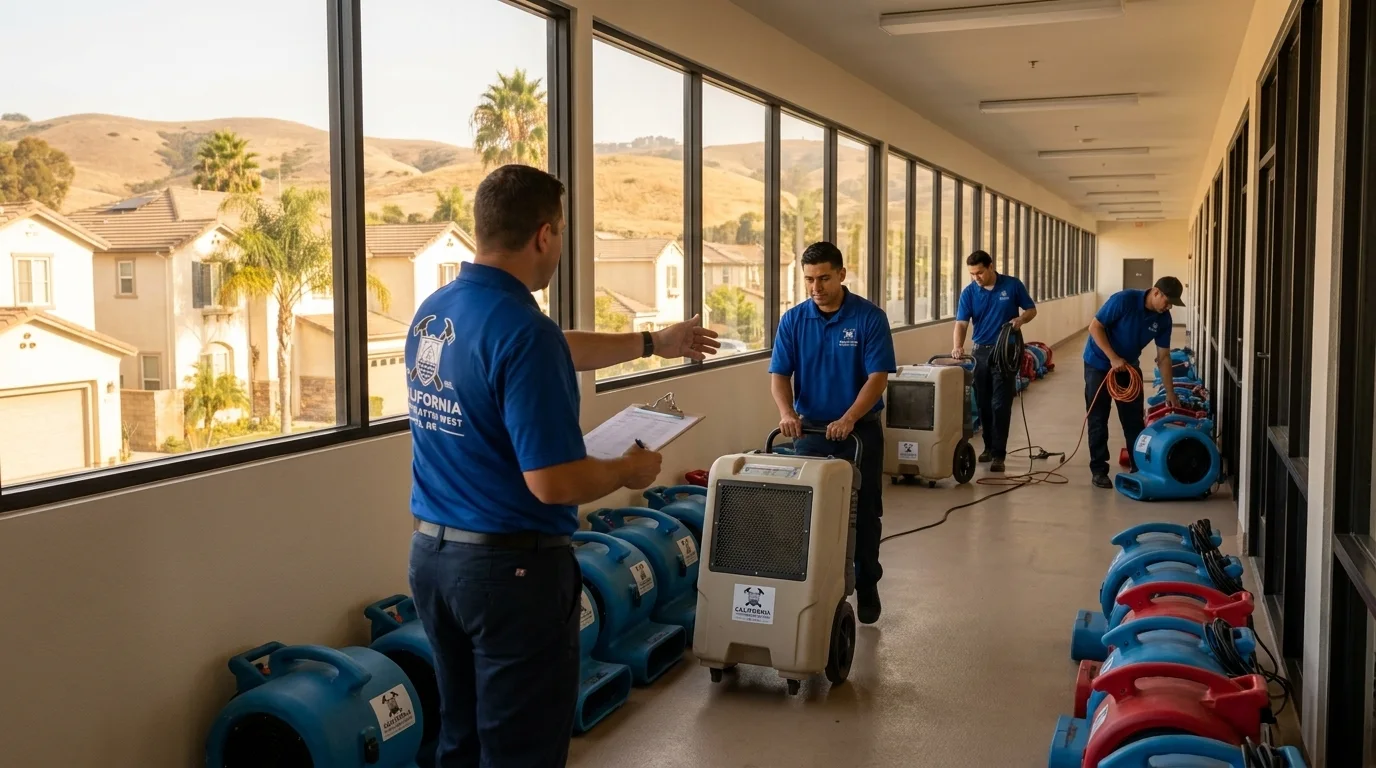
Large loss work is defined less by the type of damage and more by its scale and complexity: multi-unit apartment buildings, hotels, manufacturing facilities, schools, hospitals, or large single-family estates where the affected square footage, number of trades required, or dollar value of the claim exceeds what a standard residential crew is set up to handle. It often means coordinating water extraction, structural drying, demolition, contents handling, and reconstruction simultaneously across different sections of a property, sometimes with different categories of contamination in different areas. Equipment needs scale accordingly: dozens of air movers and dehumidifiers running on a monitored drying log, desiccant units for large open spaces like warehouses or gymnasiums, and generator power when a building’s electrical service has been compromised. Timelines are measured in weeks or months rather than days, and the work typically runs alongside a general contractor, a structural engineer, or a third-party administrator managing the claim.
Our process
- Rapid site assessment and mobilization. Our IICRC-certified team walks the full property to scope the extent of damage, identify life-safety hazards, and determine how many trades and how much equipment the loss requires before a single piece of equipment is placed.
- Emergency mitigation across all affected areas. Water extraction, board-up, tarping, or debris removal begins simultaneously in multiple zones rather than sequentially, to stop secondary damage from spreading while the broader scope is finalized.
- Structural drying and moisture mapping at scale. Moisture readings are logged by zone and tracked against an IICRC S500 drying standard, with daily monitoring reports generated for the adjuster, the property manager, and any engineer involved in the claim.
- Trade coordination and reconstruction scope. Demolition, mold containment where needed, and rebuild scopes are sequenced so that drying, remediation, and reconstruction crews aren’t working against each other on the same timeline.
- Documentation built for large-dollar claims. Photos, moisture logs, equipment placement records, and daily progress reports are compiled in a format large loss adjusters expect to see, because undocumented work is the single biggest reason large claims stall.
What separates a good large loss response from a bad one
The most common failure on a catastrophic loss isn’t bad drying technique, it’s under-resourcing: a contractor takes the job without enough equipment or labor to actually dry or secure the whole property, and damage keeps spreading in areas that haven’t been touched yet. Another frequent mistake is poor documentation. Large loss adjusters and TPAs are looking for daily moisture logs, clear photo timestamps, and equipment counts that justify the invoice, not a lump-sum estimate at the end. Mixing categories of water (clean water from a sprinkler system versus contaminated water from a sewer backup in a different wing) without separate containment and handling protocols is another gap that shows up in claim disputes later. A strong large loss response keeps a single point of contact coordinating every trade, maintains a drying and demolition log an adjuster can audit at any point, and sequences reconstruction so rebuild work doesn’t start in a space that hasn’t actually reached dry standard yet.
What does large loss and catastrophic response cost?
Large loss costs vary enormously depending on square footage, number of affected units, category of contamination, and how much reconstruction is involved, so there’s no single number that applies across property types. Every loss gets a written scope before work begins, and California Restoration West does not quote blanket pricing over the phone for commercial or multi-unit losses. Commercial property insurance and larger homeowners or landlord policies typically cover mitigation, drying, and reconstruction costs tied to a covered peril, though business interruption and code-upgrade coverage vary by policy.
| Scenario | Typical range |
|---|---|
| Multi-unit apartment building, water loss (2-4 units) | $25,000 - $90,000 |
| Commercial building, sprinkler or pipe failure (full floor) | $50,000 - $200,000 |
| Large structure fire with partial collapse | $150,000 - $750,000 |
| Hotel or multi-tenant property, major water event | $100,000 - $500,000 |
| Catastrophic storm damage, multi-building commercial site | $300,000 - $2,000,000+ |
Seasonal & regional considerations
Ventura County’s large loss events tend to cluster around two patterns: winter atmospheric river storms that overwhelm aging roofs and drainage on commercial and multifamily properties, and wildfire-driven losses where smoke, fire, and firefighting water combine to damage structures that weren’t directly in the burn path. Older commercial buildings along the coast and in downtown corridors often have outdated plumbing or roofing systems that fail catastrophically rather than gradually once stressed, which is part of why large loss calls in this region spike after a heavy storm season or a nearby fire event.
Service area
California Restoration West responds to large loss and catastrophic events throughout Ventura and the surrounding communities, including Oxnard, Camarillo, Thousand Oaks, and Santa Paula, mobilizing additional crews and equipment as a loss requires.
If you’re managing a loss that’s outgrown what a single contractor can handle, call (805) 290-7292 to get a large loss response team scoping the property and a written plan in motion.
Frequently Asked Questions
Does homeowners or commercial insurance cover large loss and catastrophic restoration?
What qualifies as a 'large loss' versus a standard residential claim?
How is a multi-building or multi-unit loss coordinated without delaying individual units?
What documentation do large loss adjusters typically require?
Can mitigation and reconstruction run at the same time on a large loss, or do they have to happen in sequence?
Looking for the best large loss and catastrophic response company in Ventura?
California Restoration West provides large loss and catastrophic response in Ventura, CA and the surrounding area, and has served local property owners since 2025. Customers rate us 5.0 out of 5 stars across 9 Google reviews. We answer calls 24/7 — call (805) 290-7292 for immediate help.
Need Large Loss and Catastrophic Response now?
We respond 24/7 across Ventura and surrounding CA cities.
Related Coverage
- Our Restoration Services
- Contact California Restoration West
- Restoration Services in Camarillo
- Restoration Services in Carpinteria
- Restoration Services in Castaic
- Restoration Services in Fillmore
- Restoration Services in Hasley Canyon
- Restoration Services in Lake Sherwood
- Restoration Services in Mira Monte
- Restoration Services in Moorpark
- Restoration Services in Oak Park
- Restoration Services in Oak View
- Restoration Services in Ojai
- Restoration Services in Oxnard