
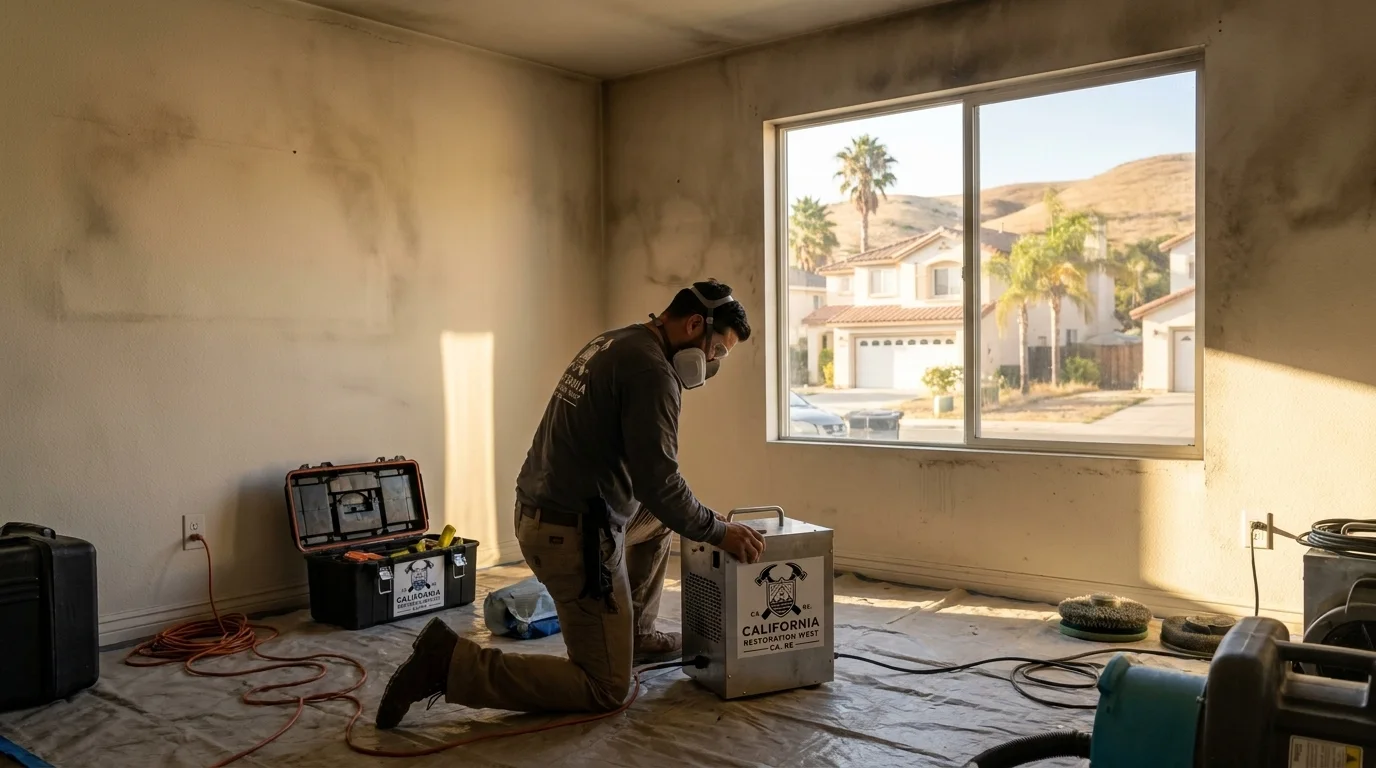
Odor Removal and Deodorization in Ventura
24/7 odor removal and deodorization in Ventura and surrounding areas. IICRC-certified, insurance billing accepted. Call (805) 290-7292.
A week after the fire is out, or the floodwater recedes, or the sewage backup gets cleaned up, the smell is still there. It has moved into the drywall, settled into the HVAC ductwork, absorbed into upholstered furniture and the subfloor beneath the carpet. Surface cleaning does not touch it. Air fresheners mask it for a few hours. Professional odor removal and deodorization is a different category of work entirely, one that targets the molecular source of the odor rather than covering it up.
What Odor Removal and Deodorization actually involves
Odor molecules bond to porous materials at a microscopic level. Smoke residue from a structure fire carries soot particles and volatile organic compounds that penetrate painted drywall, wood framing, insulation, and soft contents. Sewage and floodwater leave biological compounds that continue off-gassing long after visible moisture is gone. Pet urine crystallizes in subfloor wood and concrete and reactivates with humidity.
Professional odor elimination uses a combination of methods matched to the odor source and the materials affected. Thermal fogging disperses a deodorizing agent as a fine mist that follows the same pathways smoke or gases traveled, reaching into wall cavities and ceiling spaces that surface spraying cannot access. Ozone treatment generates O3 molecules that oxidize odor compounds on contact, effective for smoke odor removal in unoccupied spaces. Hydroxyl deodorization uses UV-generated hydroxyl radicals to break down odor molecules and is safe to run in occupied or semi-occupied structures. Enzymatic treatments target biological odors, breaking down the organic compounds at the source rather than neutralizing the smell chemically.
The right method, or combination of methods, depends on the odor type, the materials involved, and whether the space needs to remain accessible during treatment. An ozone generator left running in a sealed room for the wrong duration can damage rubber seals, electronics, and artwork. Thermal fogging in the wrong concentration leaves residue. Equipment selection and dwell time matter as much as the equipment itself.
Our process
-
Source identification and odor mapping. Before any equipment is deployed, the affected areas are assessed to identify the odor source, the materials it has penetrated, and how far it has migrated. Smoke odor in a kitchen fire behaves differently than smoke odor from a whole-structure loss. Biological odors require locating the origin point, which is not always where the smell is strongest.
-
Contaminated material removal and surface cleaning. Deodorization equipment cannot overcome a persistent source. Charred materials, saturated insulation, or porous contents that cannot be restored are removed first. Affected surfaces are cleaned of residue using appropriate agents for the substrate, whether that is soot sponging on painted walls, enzymatic pre-treatment on concrete, or HEPA vacuuming of ductwork.
-
Primary deodorization treatment. The appropriate technology is applied based on the assessment: thermal fogging for smoke penetration into cavities, hydroxyl deodorization for occupied or sensitive environments, ozone treatment for sealed unoccupied spaces, or enzymatic application for biological odors. In complex losses, more than one method is used in sequence.
-
Dwell time and ventilation. Each treatment method requires a specific dwell period to be effective. After treatment, the space is ventilated to clear treatment byproducts and allow a clearance assessment.
-
Verification and re-treatment if needed. The space is assessed after ventilation. If odor persists in specific areas, localized re-treatment targets those zones. The goal is a result that holds, not one that fades back within days.
What separates a good odor removal response from a bad one
The most common failure in professional odor elimination is treating the symptom rather than the source. Running an ozone machine in a room that still has smoke-saturated insulation behind the walls will produce a temporary result. The odor returns within days as the untreated material continues to off-gas. Insurance adjusters reviewing odor-related claims look for documentation of source removal, not just treatment application.
A second common problem is mismatched technology. Ozone treatment is effective for smoke odor removal in the right conditions, but it requires the space to be unoccupied and sealed, and it can degrade certain materials if overdosed. Hydroxyl deodorization is slower but safer for occupied environments and sensitive contents. Using the wrong method for the situation wastes time and can cause secondary damage.
For smoke odor specifically, the type of combustion matters. Protein fires from cooking leave a nearly invisible but intensely pungent residue that requires different chemistry than the wet, black soot from synthetic materials burning in a structure fire. A technician who applies the same protocol to both will get poor results on one or both.
Documentation throughout the process, including pre-treatment odor assessment notes, treatment methods and dwell times, and post-treatment verification, supports insurance claims and gives the homeowner a record if odor recurs.
What does Odor Removal and Deodorization cost?
Typical costs for professional odor elimination vary significantly based on the odor source, the size of the affected area, the materials involved, and the number of treatment cycles required. Most homeowners pay somewhere in the following ranges for common scenarios, though every loss is different and California Restoration West provides a written scope before any work begins.
| Scenario | Typical industry range |
|---|---|
| Single room, smoke odor (small fire or isolated source) | $400 - $1,200 |
| Whole-structure smoke odor removal after structure fire | $2,500 - $8,000+ |
| Biological odor (sewage, pet urine, single area) | $500 - $2,000 |
| Whole-home biological or flood-related odor | $1,500 - $5,000 |
| HVAC duct deodorization (standalone) | $300 - $900 |
| Contents deodorization (pack-out and treatment) | $800 - $3,500 |
Homeowners insurance typically covers odor removal when it results from a covered peril such as fire, smoke, or a sudden water loss. Coverage for pet odor or gradual odor buildup is generally excluded. California Restoration West works with all major carriers and handles claim documentation throughout the process.
Seasonal and regional considerations
Ventura County’s climate creates specific odor conditions worth knowing. The marine layer that keeps coastal areas cool and humid through spring and early summer also keeps moisture levels elevated in building materials, which accelerates mold-related odor development after any water intrusion and reactivates dormant biological odors in subfloor and crawl space materials. Inland areas of the county see higher summer temperatures that intensify off-gassing from smoke-damaged materials, making prompt treatment more urgent in those zones.
Wildfire smoke is a recurring concern throughout the region. Fine particulate smoke from vegetation fires penetrates building envelopes differently than structural fire smoke, depositing odor-bearing compounds across large areas of a home even when the structure itself was not directly involved. Homes in hillside neighborhoods with wood siding and older window seals are particularly susceptible to smoke infiltration during fire events.
Service area
California Restoration West is based in Ventura and provides odor removal and deodorization services throughout Ventura County, including Oxnard, Camarillo, Thousand Oaks, Simi Valley, Santa Paula, Fillmore, Moorpark, and Port Hueneme. City-specific service pages cover local details for each area.
If your home or property still carries the smell of smoke, water damage, or a biological event, the source is still active. Call California Restoration West at (805) 290-7292 to schedule an odor source assessment and get a written scope for professional odor elimination.
Services We Handle
- Odor Control & Deodorization
- Remove Pet Stains and Odors
Frequently Asked Questions
Does homeowners insurance cover odor removal and deodorization?
What is the difference between ozone treatment and hydroxyl deodorization, and how do I know which one my situation needs?
Why does smoke odor come back a few days after it seemed like the problem was fixed?
How long does professional odor removal take from start to finish?
Can thermal fogging damage my belongings or finishes?
Looking for the best odor removal and deodorization company in Ventura?
California Restoration West provides odor removal and deodorization in Ventura, CA and the surrounding area, and has served local property owners since 2025. Customers rate us 5.0 out of 5 stars across 9 Google reviews. We answer calls 24/7 — call (805) 290-7292 for immediate help.
Need Odor Removal and Deodorization now?
We respond 24/7 across Ventura and surrounding CA cities.
Related Coverage
- Our Restoration Services
- Contact California Restoration West
- Odor Removal and Deodorization in Camarillo
- Odor Removal and Deodorization in Carpinteria
- Odor Removal and Deodorization in Castaic
- Odor Removal and Deodorization in Fillmore
- Odor Removal and Deodorization in Hasley Canyon
- Odor Removal and Deodorization in Lake Sherwood
- Odor Removal and Deodorization in Mira Monte
- Odor Removal and Deodorization in Moorpark
- Odor Removal and Deodorization in Oak Park
- Odor Removal and Deodorization in Oak View
- Odor Removal and Deodorization in Ojai
- Odor Removal and Deodorization in Oxnard
- Odor Removal and Deodorization in Piru
- Odor Removal and Deodorization in Port Hueneme
- Odor Removal and Deodorization in San Buenaventura (Ventura)
- Odor Removal and Deodorization in Santa Paula
- Odor Removal and Deodorization in Santa Rosa Valley
- Odor Removal and Deodorization in Simi Valley
- Odor Removal and Deodorization in Somis
- Odor Removal and Deodorization in Thousand Oaks