TL;DR: Contents restoration is the process of cleaning, deodorizing, and storing your personal belongings after a water, fire, mold, or storm loss. Most items, including furniture, documents, electronics, and clothing, can be restored rather than replaced if a crew responds quickly. A certified restoration company inventories every item, packs it out to a climate-controlled facility, restores it, and returns it once your home is ready. Your homeowners insurance typically covers this as part of your personal property claim.
Your home in Ojai took a hit, and now you’re staring at furniture soaked from a burst pipe, smoke-damaged artwork, or belongings sitting in a room that still smells like mold. The structure gets most of the attention during a loss, but your contents are often where the emotional and financial weight lands. The good news: most of what you own is recoverable, and the process is more systematic than most homeowners expect.
What Does Contents Restoration Actually Include?
Contents restoration covers the cleaning, deodorizing, drying, and storage of your personal belongings after a covered loss. It is a separate scope from structural drying or mold remediation, though it often runs in parallel. The process applies to furniture, clothing, electronics, documents, artwork, appliances, and collectibles.
The scope breaks into four phases:
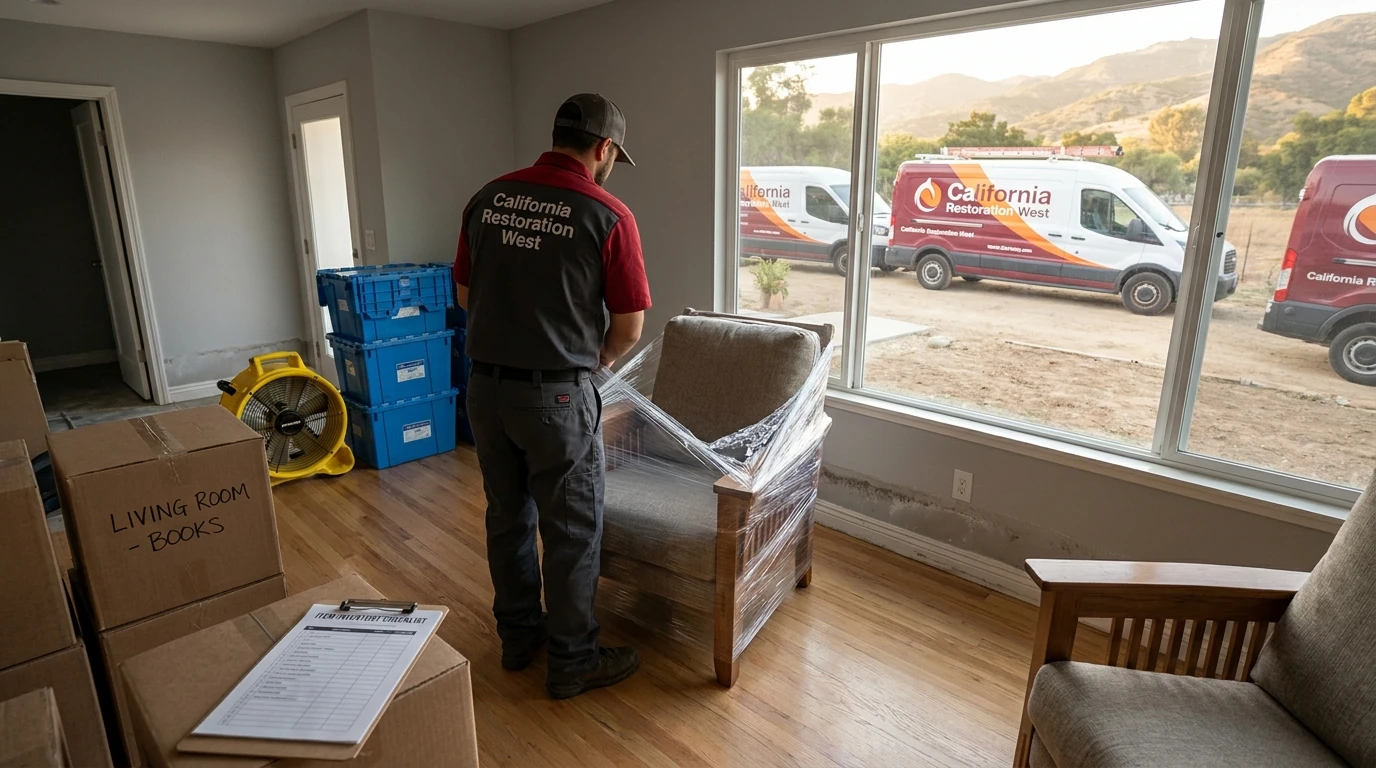
- Inventory and pack-out. A crew photographs and itemizes every affected item before anything moves. This documentation protects your insurance claim and gives you a record if anything is disputed later. Items are labeled, boxed, and transported.
- Cleaning and treatment. Depending on the damage type, items go through ultrasonic cleaning, ozone or hydroxyl deodorization, freeze-drying (for documents and photos), or dry-cleaning. Soot-coated items need a different process than water-saturated ones.
- Climate-controlled storage. While your home is being dried or rebuilt, your belongings stay in a secure, temperature- and humidity-controlled facility. This prevents secondary mold growth on items that were already cleaned.
- Return and re-installation. Once the structure is cleared, the crew delivers your items back and helps place them.
The IICRC S520 standard governs mold-affected contents; the S500 standard covers water-damaged contents. Crews certified to these standards follow documented protocols rather than guessing at what’s salvageable.
What Can Actually Be Restored After a Loss?
Most contents are restorable if the response is fast and the damage category is low. Here is a realistic breakdown by item type:
Usually restorable:
- Upholstered furniture (if dried within 24-48 hours per IICRC S500 guidelines)
- Hard-surface furniture (wood, metal, laminate)
- Clothing and textiles (ozone treatment or dry-cleaning)
- Documents and photos (freeze-drying, if caught early)
- Electronics (after professional drying and inspection, not DIY rice tricks)
- Appliances with no electrical damage
Restorable with conditions:
- Mattresses (Category 1 water only, clean water source; Cat 2 or Cat 3 contact usually means replacement)
- Books (freeze-drying works, but warping is common)
- Particle-board furniture (absorbs water quickly; replacement is often cheaper)
Typically not restorable:
- Items with Category 3 (black water) saturation, meaning sewage, floodwater, or heavily contaminated sources
- Porous materials with active mold growth that cannot be fully cleaned
- Items with structural fire damage, not just smoke
The damage category matters. Category 1 is clean water (a supply line break). Category 2 is gray water (a washing machine overflow). Category 3 is black water (sewage backup, storm flooding). The higher the category, the more items shift from “restore” to “replace” on the adjuster’s scope.
Ojai’s position in the Ojai Valley means homes near the Ventura River corridor and the Shelf Road area can see flash flooding after heavy rain events, which typically brings Category 3 water into lower-level spaces. If your loss involved standing water from an outdoor source, assume Cat 3 until a crew tests and confirms otherwise.
How Does Contents Storage Work During Restoration?
Contents storage is not a warehouse with boxes stacked in a corner. A legitimate pack-out and storage process uses a documented chain of custody from the moment items leave your home.
Here is what that looks like in practice:
- Every item gets a barcode or tag tied to a digital inventory. You can request a copy of this list, and your adjuster will want one.
- The storage facility is climate-controlled, typically held between 65-75 degrees Fahrenheit with relative humidity below 50%. This prevents mold from developing on items that were already cleaned.
- Items are stored in sealed containers or on shelving, not piled loose.
- Access is logged. You should be able to request a specific item (say, a medication or a piece of equipment you need for work) and have it pulled.
Storage duration depends on your structural timeline. A straightforward water-damage dry-out might take 3-5 days. A mold remediation job in a Craftsman bungalow in the East End of Ojai, where older construction often means more porous materials and tighter wall cavities, can run 2-4 weeks. Fire damage with reconstruction can stretch to months. Your contractor should give you a written timeline estimate before pack-out begins.
For insurance purposes, contents storage costs are typically covered under your Additional Living Expenses (ALE) or personal property coverage, depending on your policy. Ask your adjuster specifically whether pack-out, cleaning, and storage are itemized in your claim or rolled into a lump-sum personal property settlement.
What Should You Ask Before Signing a Contents Scope?
Before a crew starts inventorying your home, get clear answers to these questions:
Who holds the inventory? You should receive a copy of the itemized list before anything leaves your property. Never let a crew pack out without documentation.
What cleaning methods are used for each item type? Ultrasonic cleaning, ozone, hydroxyl, freeze-drying, and dry-cleaning are not interchangeable. A competent crew explains which method applies to which item and why.
Where is the storage facility? It should be a secured, climate-controlled location, not a crew member’s garage. Ask for the address.
What is the return process? Get in writing that delivery and re-installation are included in the scope, not billed separately at the end.
What happens to items deemed non-restorable? The crew should document these separately and provide a replacement cost value (RCV) list for your adjuster. You should not be charged for cleaning items that were written off.
If your loss involved both structural damage and contents, make sure your contractor is coordinating the two scopes. A home that is dried and cleared structurally while your belongings are still in a damp storage unit defeats the purpose.
What to Do Right Now If You Have Damaged Contents
The first 24 to 48 hours after a loss are the window that determines what is salvageable. Mold can begin colonizing wet porous materials within 24 hours, according to the EPA’s mold guidance. Soot from fire damage becomes chemically bonded to surfaces within hours if not treated.
Do these things immediately:
- Stop the source of damage if it is still active (shut off the water supply, call the utility for gas or electrical hazards).
- Do not run fans or HVAC through a mold-affected space, as this spreads spores.
- Do not throw anything away before it is inventoried. Discarded items cannot be claimed.
- Document everything yourself with photos and video before a crew arrives.
- Call your insurance company to open a claim, then call a restoration contractor.
For contents restoration and storage in Ojai, California Restoration West handles the full pack-out, cleaning, and storage scope alongside structural mitigation. They are an IICRC Certified Firm with Water Damage Restoration Technician (WRT) and Applied Structural Drying (ASD) certifications, available 24/7. Reach them at (805) 290-7292.
If you are also dealing with structural water damage alongside your contents loss, the post on what to do in the first 24 hours after water damage covers the structural side step by step. For mold concerns on items or in the structure, see how soon mold grows after water damage for the timeline you are working against.
About California Restoration West
California Restoration West is an IICRC Certified Firm serving Ojai, Ventura, and surrounding Ventura County communities since 2025 (licensed and insured). Their crews hold IICRC certifications in Water Damage Restoration (WRT), Applied Structural Drying (ASD), and Applied Microbial Remediation (AMRT), and are OSHA trained. Services include contents restoration and storage, water damage restoration, mold remediation, odor removal, storm damage restoration, and crawl space encapsulation. Available 24/7 at (805) 290-7292.