
Crawl Space Encapsulation in Santa Rosa Valley
24/7 crawl space encapsulation in Santa Rosa Valley, CA. IICRC-certified, insurance billing accepted. Call (805) 290-7292.
Our IICRC-certified technicians are dispatched from our Ventura, CA headquarters and are typically on-site in Santa Rosa Valley within 60 minutes of your call.
Santa Rosa Valley sits in a coastal-influenced inland corridor where marine air from the Pacific pushes through the Conejo Grade and settles into the valley floor most mornings. That daily cycle of moisture-laden air infiltrating beneath homes with vented crawl spaces creates conditions that are genuinely different from drier inland communities. Crawl space encapsulation addresses that cycle directly, sealing the underside of your home against the humidity that otherwise condenses on joists, insulation, and subfloor sheathing year after year.
Why Santa Rosa Valley Properties Are Particularly Vulnerable
The valley’s topography channels cool, damp air from the coast while the surrounding hills trap it overnight. Homes built on the valley floor, where the soil retains moisture well into summer, experience crawl space humidity levels that can stay elevated even during dry months. Older ranch-style homes common to this area often have shallow crawl spaces with minimal clearance and original fiberglass batt insulation that absorbs and holds moisture rather than repelling it. Once that insulation becomes saturated, it loses its thermal value and begins to support mold colonization on the wood framing above it. The IICRC AMRT standard recognizes this pattern: surface readings can appear acceptable while the structural members above a wet vapor barrier remain at elevated moisture content for weeks.
Vented crawl spaces were the standard construction practice for decades in Ventura County, and many Santa Rosa Valley homes still rely on passive cross-ventilation that simply cannot keep up with the valley’s microclimate. When outdoor relative humidity stays above 70 percent for extended periods, those vents bring the problem in rather than pushing it out.
Our Crawl Space Encapsulation Process in Santa Rosa Valley
Encapsulation is not a single-step product installation. The process begins with a thorough inspection of the crawl space floor, perimeter walls, existing vapor barrier (if any), insulation condition, and wood moisture content readings taken at multiple points. Any standing water, active drainage issues, or existing mold growth is addressed before a single inch of liner goes down.
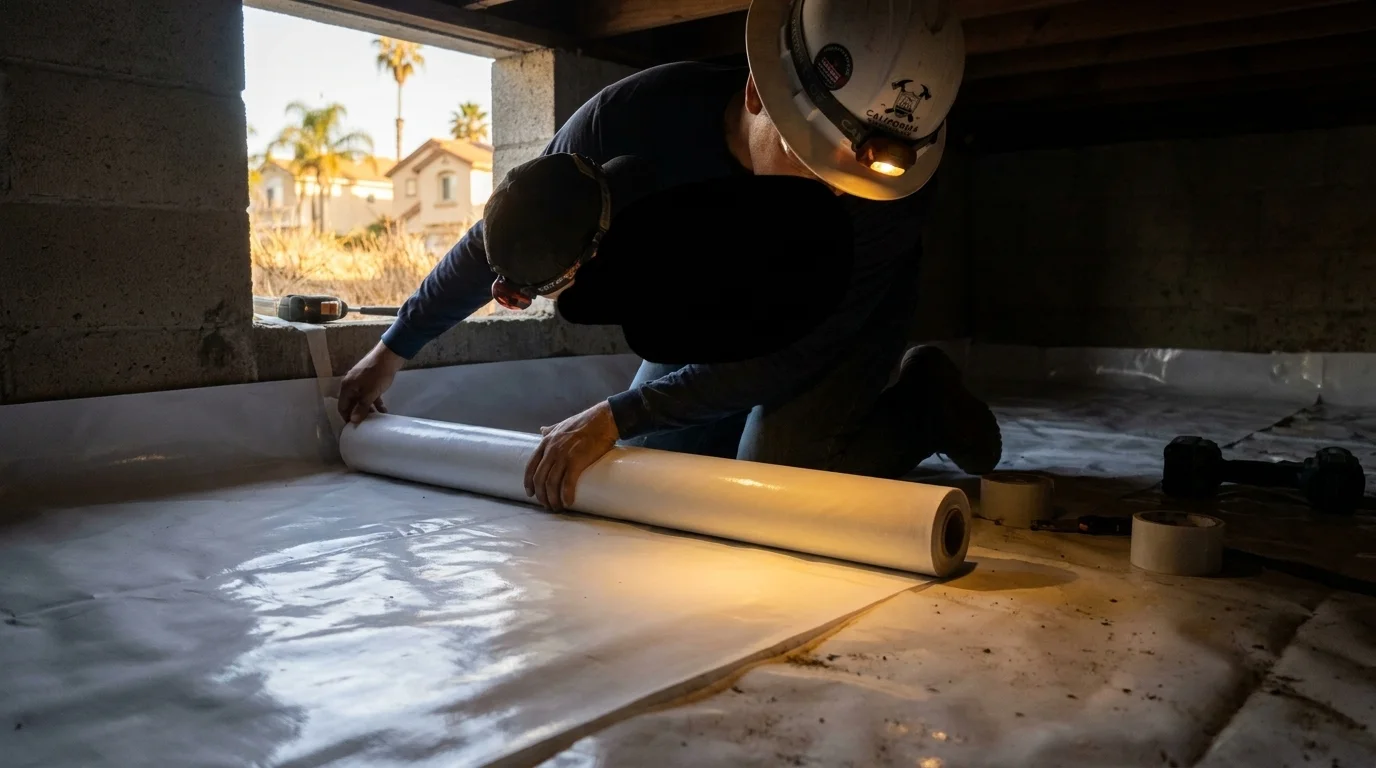
The liner itself is a reinforced polyethylene barrier, typically 20-mil, that covers the ground surface and runs up the perimeter foundation walls, sealed at seams and penetrations with compatible tape and mastic. Vents are sealed as part of the system. A crawl space that is properly encapsulated functions as a semi-conditioned space: temperature and humidity inside track the conditioned living area above rather than the outdoor air below. In Santa Rosa Valley’s climate, that shift alone can reduce crawl space relative humidity by 30 to 50 percentage points during peak marine layer months.
Where moisture levels are elevated, a dedicated crawl space dehumidifier is sized and installed to maintain conditions below the threshold where mold can establish. Our team holds IICRC AMRT and IICRC ASD certifications, which means the drying science behind equipment selection is the same science used in structural drying after water damage events, not a rough estimate.
Reaching Santa Rosa Valley from Ventura
California Restoration West operates from Ventura and is available around the clock. The most direct route to Santa Rosa Valley runs east on the 101 to the 23 North, then into the valley via Moorpark Road or Tierra Rejada Road depending on which part of the valley the property sits in. Under normal traffic conditions that corridor is straightforward, and our team can coordinate scheduling and arrival windows directly when you call (805) 290-7292.
Santa Rosa Valley Insurance and HOA Considerations
Crawl space encapsulation is sometimes covered under homeowner’s insurance when it is performed as part of a documented water damage or mold remediation claim. Whether coverage applies depends on the cause of loss and your specific policy language. Our IICRC Certified Firm status and OSHA-trained crew means documentation is thorough: moisture readings, photo logs, and scope of work are formatted in the way most carriers expect to receive them.
Many properties in this area fall under HOA oversight, and some associations have specific requirements around exterior access panels, drainage modifications, or documentation before and after work on the building envelope. If your property has an HOA, it is worth confirming their notification requirements before work begins. We can provide scope documentation to support that process.
Local Note
Santa Rosa Valley’s ranch and estate properties often have crawl spaces that were designed for a drier climate assumption, with vents positioned to catch prevailing winds that, in practice, carry marine moisture rather than dry air. A detail worth knowing: the valley floor near Tierra Rejada Road tends to have clay-heavy soil that drains slowly after rain events, which means standing water under a home can persist long after the surface appears dry. If your crawl space inspection follows a wet winter, moisture readings taken at the soil surface alone will understate the actual condition. Readings need to be taken at the wood framing above, not just at the liner level, to get an accurate picture before encapsulation materials go in.
If you are noticing musty odors in your living space, soft spots in flooring, or elevated heating and cooling costs, the crawl space is the right place to start. Call California Restoration West at (805) 290-7292 to schedule an inspection for your Santa Rosa Valley property.
Serving Santa Rosa Valley from our Ventura headquarters — ★ 5.0 · 9 Google reviews
“Excellent work! Lots of experience and professionalism!” — Adan, November 2025Read our reviews on Google →
Crawl Space Encapsulation in Santa Rosa Valley: Service Coverage
Frequently Asked Questions
How fast can you arrive for crawl space encapsulation in Santa Rosa Valley?
Does Santa Rosa Valley's marine layer climate actually affect crawl spaces year-round, or just in winter?
My Santa Rosa Valley home has the original fiberglass batt insulation in the crawl space. Does that need to come out before encapsulation?
Is crawl space encapsulation something Santa Rosa Valley HOAs typically require documentation for?
What does the encapsulation liner material actually look like, and how long does it last in this climate?
How does clay soil near Tierra Rejada Road affect the encapsulation process compared to other parts of the valley?
Will my homeowners insurance cover crawl space encapsulation in Santa Rosa Valley?
Crawl Space Encapsulation response in Santa Rosa Valley
Most Santa Rosa Valley calls see a technician on-site within 60 minutes from our Ventura headquarters.