
Mold Remediation in Santa Rosa Valley
24/7 mold remediation in Santa Rosa Valley, CA. IICRC-certified, insurance billing accepted. Call (805) 290-7292.
Our IICRC-certified technicians are dispatched from our Ventura, CA headquarters and are typically on-site in Santa Rosa Valley within 60 minutes of your call.
Santa Rosa Valley sits in a narrow inland corridor where marine air funnels in from the Pacific through gaps in the Santa Monica Mountains, then stalls against the warmer valley floor. That pattern keeps relative humidity elevated longer than most of Ventura County’s coastal communities, and when a slow roof leak or a sweating water line goes unnoticed for even a few days, the conditions are already right for mold to take hold inside wall cavities and beneath flooring. California Restoration West’s IICRC-certified mold remediation team works throughout the valley, responding around the clock to contain growth before it spreads further into your home’s structure.
Why Santa Rosa Valley Properties See Mold Issues
The valley’s topography does most of the work. Warm, dry air rises through the day, then cools sharply at night, pushing moisture back down into crawl spaces, attics, and any wall assembly that isn’t well-sealed. Homes built in the 1980s and 1990s, which make up a large share of the residential stock here, were often framed with OSB sheathing and paper-faced insulation that absorbs moisture readily. Once the paper facing on fiberglass batts gets wet, it becomes a reliable food source for mold colonies, and the problem is rarely visible from inside the living space until the infestation is already well established.
Irrigation is another factor that doesn’t get enough attention. Santa Rosa Valley’s large lots typically run extensive drip and spray systems, and a slow leak at a valve box near a foundation can saturate the soil against a stem wall for months before anyone notices. That sustained ground contact wicks moisture into concrete block and wood framing at the sill plate, creating a zone that reads dry at the surface but stays damp several inches in.
Our Mold Remediation Process in Santa Rosa Valley
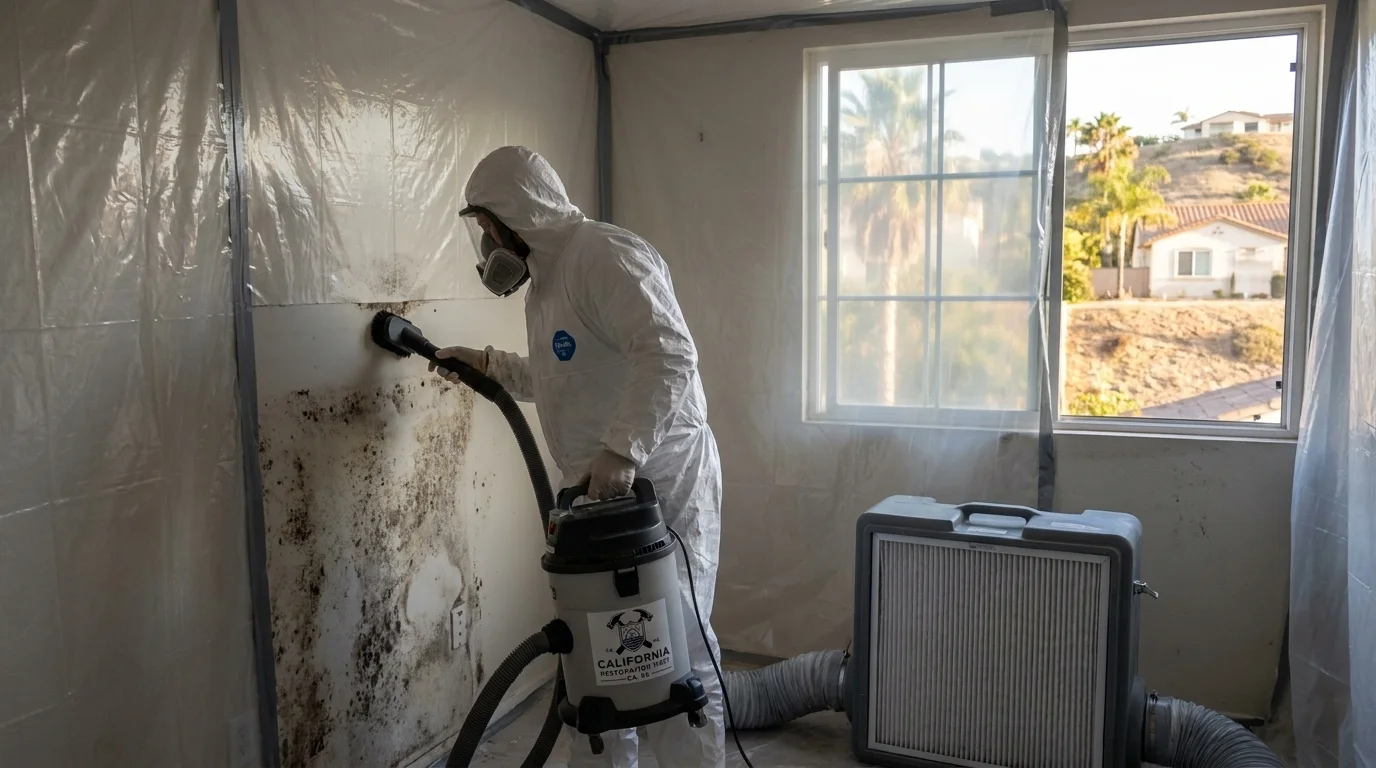
Every job starts with a thorough moisture mapping session using thermal imaging and calibrated moisture meters. Surface readings alone miss the pockets of saturation that feed active mold growth, so the inspection goes behind baseboards, into attic knee walls, and under subfloor panels where conditions are worst. Once the affected zones are identified, the crew establishes negative-air containment with 6-mil poly barriers and HEPA-filtered air scrubbers before any material is disturbed. This keeps spores from migrating to unaffected rooms during removal.
Contaminated drywall, insulation, and wood framing that cannot be cleaned to a visually clean standard are removed and bagged in sealed poly before being transported off-site. Structural wood that remains is treated with an EPA-registered antimicrobial solution and dried to the IICRC S520 standard before any reconstruction begins. Air clearance testing by an independent industrial hygienist is available to confirm that spore counts have returned to normal background levels, which is increasingly expected by both lenders and buyers in Ventura County’s active real estate market.
Reaching Santa Rosa Valley from Ventura
The team dispatches from Ventura and reaches Santa Rosa Valley via the 101 north to the Wendy Drive or Moorpark Road exits, depending on which part of the valley the job is in. Because the valley’s road network is largely residential with limited through-routes, the crew confirms the best access point when you call so there’s no delay once they’re on-site. Calls are answered 24 hours a day, every day, so you can reach a live person whether the problem surfaces at noon or 2 a.m.
Santa Rosa Valley Insurance Coordination
Mold claims in Ventura County often hinge on whether the growth is tied to a sudden, accidental water event or to long-term seepage, and insurers scrutinize that distinction carefully. The documentation process here is built with that in mind: moisture readings are logged with timestamps, affected materials are photographed before and after removal, and a written scope of work is prepared in a format that most major carriers accept for direct billing. If your policy includes mold coverage, the paperwork is handled on your behalf so the claim moves forward without you having to manage the back-and-forth.
Local Note
Santa Rosa Valley’s equestrian properties introduce a detail that purely residential remediation rarely encounters: tack rooms, feed storage areas, and barn-adjacent living quarters often share HVAC returns or attic space with the main house. Hay dust and animal dander give mold spores additional surfaces to colonize, and cross-contamination between a barn structure and an attached casita can happen faster than in a standard single-family home. When a mold job involves a property with outbuildings or converted barn space, the inspection scope needs to account for those shared air pathways before containment is set up.
If you’re seeing discoloration on drywall, catching a musty odor that lingers after airing out a room, or dealing with the aftermath of a plumbing leak or roof intrusion, call California Restoration West at (805) 290-7292. The team serves Santa Rosa Valley around the clock and can have a certified technician on-site to assess the situation and begin containment the same day you call.
Serving Santa Rosa Valley from our Ventura headquarters — ★ 5.0 · 9 Google reviews
“Excellent work! Lots of experience and professionalism!” — Adan, November 2025Read our reviews on Google →
Mold Remediation in Santa Rosa Valley: Service Coverage
Frequently Asked Questions
How fast can you arrive for mold remediation in Santa Rosa Valley?
How does Santa Rosa Valley's nighttime cooling pattern affect how quickly mold spreads after a water intrusion?
Are homes in Santa Rosa Valley with large irrigated lots at higher risk for foundation-level mold?
Do Santa Rosa Valley properties with equestrian outbuildings or converted barn space require a different remediation approach?
What does the mold remediation process look like from start to finish, and how long does it typically take?
Will my homeowner's insurance cover mold remediation in Santa Rosa Valley, and how does the claims process work?
Mold Remediation response in Santa Rosa Valley
Most Santa Rosa Valley calls see a technician on-site within 60 minutes from our Ventura headquarters.