24/7 Emergency Storm Damage Restoration in Santa Rosa Valley
24/7 emergency storm damage restoration in Santa Rosa Valley, CA. IICRC-certified, insurance billing accepted. Call (805) 290-7292.
Our IICRC-certified technicians are dispatched from our Ventura, CA headquarters and are typically on-site in Santa Rosa Valley within 60 minutes of your call.
Santa Rosa Valley sits in a narrow inland corridor where marine air funnels through the Conejo Grade and collides with drier conditions rolling down from the Santa Monica Mountains. That geography means storms here behave differently than they do along the Ventura coast: wind gusts accelerate through the valley floor, oak limbs come down without warning, and rain that looks moderate on a radar screen can overwhelm drainage swales and push water under doors before a homeowner has time to move furniture. When that happens, California Restoration West is available around the clock to respond.
Why Santa Rosa Valley Properties See Distinctive Storm Damage
The valley’s semi-rural character is part of its appeal, but it also shapes how storm damage unfolds. Properties here tend to sit on larger lots with mature oak and sycamore canopy, and those trees are the first thing to cause trouble in a wind event. A falling limb that punches through a tile roof opens the interior to whatever rain follows, and in this climate the follow-on moisture can be substantial even from a storm that lasts only a few hours.
Soil composition in the valley also matters. The alluvial soils common along the valley floor drain reasonably well under normal conditions, but a fast, intense storm can saturate them quickly, reducing their ability to absorb additional runoff. When that happens, water migrates toward foundations and into crawl spaces, particularly on properties where grading has settled over the years. Homes built on the hillside edges of the valley face a different problem: slope drainage can concentrate water at the base of retaining walls or along the exterior of stem-wall foundations.
The area’s custom and semi-custom home stock, much of it built in the 1980s and 1990s, often features stucco exteriors over wood framing. Stucco looks impervious but is not. A compromised weep screed or a cracked expansion joint gives storm water a direct path to the sheathing behind it, and that damage can stay hidden for weeks before it shows up as interior staining or a musty smell in a bedroom wall.
Our Storm Damage Restoration Process in Santa Rosa Valley
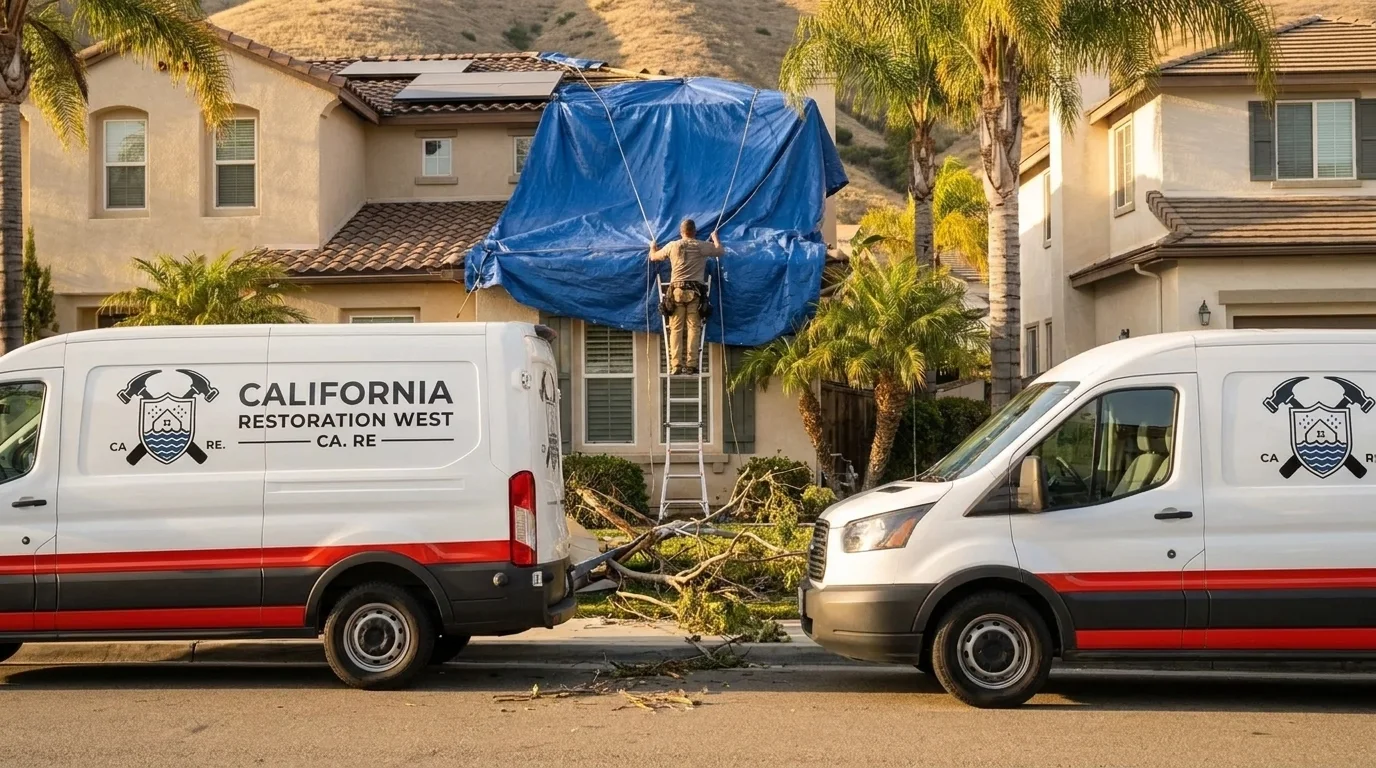
The first priority after any storm event is stopping ongoing water intrusion. That means emergency tarping of breached rooflines, boarding compromised windows or doors, and placing temporary barriers at threshold points where water is still entering. We document everything photographically before touching a material, which matters when an insurance adjuster reviews the claim.
Once the structure is stabilized, we assess moisture migration using thermal imaging and calibrated moisture meters. Water that entered through a roof breach or a failed window often travels further than it appears to: it follows framing cavities, insulation batts, and interior wall channels before pooling somewhere unexpected. In stucco-clad homes common to this area, we pay particular attention to the cavity between the stucco and the sheathing, where moisture can sit undetected.
Drying is engineered, not guessed at. We set drying targets based on the IICRC S500 and S520 standards and monitor conditions daily until affected materials reach acceptable equilibrium moisture content. Debris removal, structural repairs, and reconstruction are coordinated in sequence so the home is not left open longer than necessary.
Reaching Santa Rosa Valley from Ventura
California Restoration West is based in Ventura. The most direct route to Santa Rosa Valley runs east on the 101 to the Moorpark Road or Wendy Drive exits, then north into the valley. Under normal traffic conditions that corridor is straightforward. After a significant storm event, however, the Conejo Grade section of the 101 can see debris or reduced visibility, and surface streets through Camarillo and Moorpark may be the faster path depending on conditions. Our crews monitor road status in real time when mobilizing to storm calls, and we are available 24 hours a day, every day.
Santa Rosa Valley Insurance Coordination
Storm damage claims in this area typically involve homeowners carriers rather than the FAIR Plan, though properties in the valley’s higher fire-risk zones have seen policy changes in recent years that sometimes affect what riders are active. We document losses in the format adjusters expect: line-item scope, moisture readings with timestamps, photographs keyed to a floor plan, and material specifications for anything that requires replacement. We work directly with your carrier and can communicate with your adjuster on your behalf to reduce the back-and-forth that slows a claim down.
If your property is governed by an HOA, exterior repairs including roofing, fencing, and any work visible from the street may require architectural review. We flag those requirements early so approvals do not delay the rebuild phase.
Local Note
One thing that catches homeowners off guard in Santa Rosa Valley: the valley’s oak woodland setting means storm debris is not just branches. Acorn caps, leaf litter, and bark accumulate in gutters and on flat or low-slope roof sections over the dry season, and a single heavy rain can compact that debris into a dam that backs water under roofing material. We routinely find storm-related water intrusion that started at a clogged valley or gutter rather than at an obvious breach point. If your home has a low-slope section or a second-story deck that drains onto the main roof, those are the spots to check first after any significant wind-and-rain event.
To talk through what you are seeing at your property, call California Restoration West at (805) 290-7292. We respond to storm damage calls in Santa Rosa Valley at any hour, assess the damage honestly, and walk you through next steps before any work begins.
Serving Santa Rosa Valley from our Ventura headquarters — ★ 5.0 · 9 Google reviews
“Excellent work! Lots of experience and professionalism!” — Adan, November 2025Read our reviews on Google →
Storm Damage Restoration in Santa Rosa Valley: Service Coverage
Frequently Asked Questions
How fast can you arrive for storm damage restoration in Santa Rosa Valley?
How quickly can California Restoration West reach Santa Rosa Valley after a storm call?
Santa Rosa Valley has a lot of mature oak trees. How do you handle tree-impact damage to a roof or exterior wall?
Are stucco-clad homes in Santa Rosa Valley harder to dry out after storm water intrusion?
Does my Santa Rosa Valley HOA need to approve storm repairs before work can start?
What does the storm damage restoration timeline look like for a typical Santa Rosa Valley home?
Will my homeowners insurance cover storm damage restoration in Santa Rosa Valley?
Storm Damage Restoration response in Santa Rosa Valley
Most Santa Rosa Valley calls see a technician on-site within 60 minutes from our Ventura headquarters.
Nearby & Related
- 24/7 Emergency Storm Damage Restoration in Ventura
- Restoration Services in Santa Rosa Valley
- Mold Remediation in Santa Rosa Valley
- 24/7 Emergency Water Damage Restoration in Santa Rosa Valley
- 24/7 Emergency Storm Damage Restoration in Camarillo
- 24/7 Emergency Storm Damage Restoration in Carpinteria
- Contact California Restoration West